Today's
EarthStation1.com 15% Off Commemorative Memorial Title: The Nobel
Century Nobel Prize History TV Series DVD, MP4, USB Stick
Today, October 22, 2025
October 22: Smart Is Cool Day: --
Recognizes, appreciates, and celebrates being smart. For decades,
mainstream media has portrayed smart people as being weird
individuals with thick glasses and no personality. However, a
smart person is so much more than a sidekick who only exists to
provide some last-minute advice. They are people with rich,
interesting lives and stories worth sharing. The mainstream media
does a poor job of portraying smart people. Oftentimes, they are
used as punching bags or shown as annoying know-it-alls. Smart
kids are often made fun of, they're called nerds, and they feel
they have to play down their intelligence to avoid being teased.
There's so much more to being smart than topping the class or
getting into an Ivy League school. Smart people are generally more
empathetic, open-minded, and funny. It's time to break the
stereotypes. Smart is Cool Day is observed to change the
perception about smart people. It's cool to be smart, and it's fun
to know things. Dedicating a day to all the smart folks amongst us
is a great way to celebrate their gift. It also serves as a
motivation for everyone to become the best version of themselves.
The origins of the day remain unclear, but the cause for
celebration is not. Smart is Cool Day is the perfect opportunity
for you to embrace the perks of being smart, shamelessly. On Sale
@ 15% Off Discount Till Midnight PT!
https://store.earthstation1.com/the-nobel-century-nobel-prize-history-tv-series-dvd-mp4-us4.html
Today's
EarthStation1.com 15% Off Commemorative Memorial Title: The
Pyramids Sphinx & Cities Of Ancient Egypt MP4 Video Download
DVD
Today, October 22, 2025
October 22: The Abu Simbel Festival (Post
Summer Solstice): -- A stunning celebration held twice a year --
October 22 and February 22 -- at the magnificent Abu Simbel
temples in Egypt. During this event, sunlight perfectly
illuminates the inner sanctum, lighting up the statues of Ramses
II and the gods. This extraordinary alignment has amazed people
for centuries, drawing visitors from around the globe to witness
the wonder. The festival marks a rare moment when nature and
ancient architecture unite in a breathtaking display. On these two
special days, thousands gather at dawn to experience the magic.
The sun rises, casting golden rays through the temple's entrance,
creating a mystical atmosphere. This natural spectacle is a
tribute to the brilliance of ancient engineers who designed the
temple to honor the gods. As the sun's light touches the statues,
the crowd feels a deep connection to the past, sharing in a moment
that transcends time. The festival is not just a tourist
attraction but a celebration of human achievement and the enduring
power of the sun. The Abu Simbel Festival has roots that go back
over 3,000 years. Pharaoh Ramses II built the Abu Simbel temples
to honor himself, his family and the gods. He wanted to showcase
his power and devotion. The temples were carved out of a
mountainside in southern Egypt. They were designed with an
incredible feature: twice a year, the sun shines directly into the
innermost chamber, lighting up the statues of Ramses II and the
gods. This alignment happens on the anniversary of Ramses II's
coronation and his birthday. These dates were carefully chosen to
reflect his connection to the divine. For centuries, people have
marveled at this natural phenomenon. It's a unique blend of human
ingenuity and nature's beauty. In the 1960s, the temples were
relocated to prevent flooding caused by the Aswan High Dam.
Despite this move, the sun's alignment still occurs. Modern
celebrations began around this time, attracting people from all
over to witness this event. Today, the Abu Simbel Festival is a
vibrant celebration of history, architecture, and ancient Egypt's
genius. On Sale @ 15% Off Discount Till Midnight PT!
https://store.earthstation1.com/pyspciofaneg.html
Today's
EarthStation1.com 15% Off Commemorative Memorial Title: The
Romantic Spirit TV Series DVD, Video Download, USB Flash Drive
Today, October 22, 2025
October 22, 1811: #BOTD: #HBD! Franz
Liszt, prolific 19th-century Hungarian composer, virtuoso pianist,
conductor, music teacher, arranger, organist, philanthropist,
author, nationalist and a Franciscan tertiary (holy order members
of the Third Order of Saint Francis) during the Romantic era (d.
July 31, 1886) is #born in Raiding, Hungary. Franz Liszt (German:
Franz Liszt; Hungarian: Liszt Ferencz, in modern usage Liszt
Ferenc) gained renown in Europe during the early nineteenth
century for his prodigious virtuosic skill as a pianist. He was a
friend, musical promoter and benefactor to many composers of his
time, including Frederic Chopin, Richard Wagner, Hector Berlioz,
Robert Schumann, Camille Saint-Saens, Edvard Grieg, Ole Bull,
Joachim Raff, Mikhail Glinka, and Alexander Borodin. As a
composer, Liszt was one of the most prominent representatives of
the New German School (Neudeutsche Schule). He left behind an
extensive and diverse body of work in which he influenced his
forward-looking contemporaries and anticipated many 20th-century
ideas and trends. Some of his most notable musical contributions
were the invention of the symphonic poem, developing the concept
of thematic transformation as part of his experiments in musical
form, and making radical departures in harmony. He is best known
for the Hungarian Rhapsody No. 2, Liebestraum No. 3, and his Faust
and Dante symphonies. Franz Liszt died in Bayreuth, Kingdom of
Bavaria, German Empire, aged 74, officially as a result of
pneumonia, which he may have contracted during the Bayreuth
Festival hosted by his daughter Cosima. Questions have been posed
as to whether medical malpractice played a part in his death. He
was buried on August 3, 1886, in the municipal cemetery of
Bayreuth against his wishes. On Sale @ 15% Off Discount Till
Midnight PT!
https://store.earthstation1.com/the-romantic-spirit-tv-series-all-14-episodes-5-dual-layer-d145.html
Today's
EarthStation1.com 15% Off Commemorative Memorial Title: Peter
Ustinov's Russia TV Documentary Series DVD, Video Download, USB
Today, October 22, 2025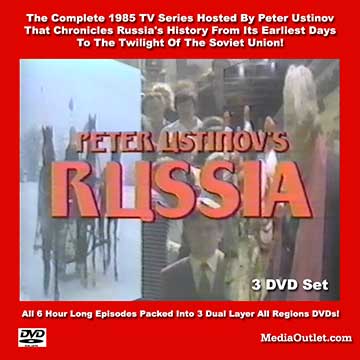
October 22, 1721: The History Of Russia
(The History Of All The Russias): The Territorial Evolution Of
Russia: The Monarchy Of Russia (The Monarchy Of All The Russias):
The Russian Empire (Imperial Russia): -- Tsar Peter I proclaims
and thereby founds The Russian Empire after the Russian victory
over the Swedes of September 10, 1721 that ended The Great
Northern War (1700-1721), declaring himself Emperor Of Russia
(Emperor And Autocrat Of All Russia, Emperor And Autocrat Of All
The Russias), the official title of the Russian monarch from 1721
to 1917. The title appeared as an adaptation of the tsar's title
under the accepted system of titling in Europe, transformed from
the previous title of Tsar And Grand Prince Of All Russia, though
the old title tsar (or tsaritsa) continued to be popularly used to
refer to the emperor (or empress) until the monarchy was abolished
in 1917. The Russian Empire was the final period of the Russian
monarchy from its proclamation in November 1721, until its
dissolution in September 1917. It consisted of most of northern
Eurasia. The Empire succeeded the Tsardom of Russia following the
Treaty of Nystad. The rise of the Russian Empire coincided with
the decline of neighbouring rival powers: the Swedish Empire, the
Polish-Lithuanian Commonwealth, Qajar Iran, the Ottoman Empire,
and Qing China. It also held colonies in Russian America between
1799 and 1867. Covering an area of approximately 22,800,000 square
kilometres (8,800,000 sq mi), it remains the third-largest empire
in history, surpassed only by the British Empire and the Mongol
Empire; it ruled over a population of 125.6 million people per the
1897 Russian census, the only census carried out during the entire
imperial period. It featured great ethnic, linguistic, religious,
and economic diversity. From the 10th to the 17th century, the
land was ruled by a noble class known as the boyars, above whom
was a tsar (later adapted as the "Emperor of all the
Russias"). The groundwork leading up to the establishment of
the Russian Empire was laid by Ivan III (1462-1505): he tripled
the territory of the Russian state and laid its foundation,
renovating the Moscow Kremlin and also ending the dominance of the
Golden Horde. His grandson, Ivan IV declared himself as "Tsar
of all Russia" in 1547. Between 1550 to 1700, Russian Tsardom
expanded by an average of 35,000 square km per year. Major events
during this era involved the transition from the Rurik to the
Romanov dynasties, Russian conquest of Siberia; and the reign of
Peter I, who transformed the tsardom into an empire. Peter I
(1682-1725) fought numerous wars and expanded an already vast
empire into a major power of Europe. During his rule, he moved the
Russian capital from Moscow to the new model city of Saint
Petersburg, which was largely built according to designs of the
Western world; he also led a cultural revolution that replaced
some of the traditionalist and medieval socio-political customs
with a modern, scientific, rationalist, and Western-oriented
system. Catherine II (1762-1796) presided the expansion of Russian
state by conquest, colonization, and diplomacy, while continuing
Peter I's policy of modernization towards a Western model.
Alexander I (1801-1825) played a major role in defeating the
militaristic ambitions of Napoleon and subsequently constituting
the Holy Alliance, which aimed to restrain the rise of secularism
and liberalism across Europe. The Russian Empire further expanded
to the west, south, and east, strengthening its position as a
European power. Its victories in the Russo-Turkish Wars were later
checked by defeat in the Crimean War (1853-1856), leading to a
period of reform and intensified expansion into Central Asia.
Alexander II (1855-1881) initiated numerous reforms, most notably
the 1861 emancipation of all 23 million serfs. His official policy
involved the responsibility of the Russian Empire towards the
protection of Eastern Orthodox Christians residing within the
Ottoman-ruled territories of Europe; this was one of the factors
that later led to the Russian entry into World War I. From 1721
until 1762, the Russian Empire was ruled by the House of Romanov;
its matrilineal branch of patrilineal German descent, the House of
Holstein-Gottorp-Romanov, ruled from 1762 until 1917. At the
beginning of the 19th century, the territory of the Russian Empire
extended from the Arctic Ocean in the north to the Black Sea in
the south, and from the Baltic Sea in the west to Alaska, Hawaii,
and California in the east. During this period, Russian Empire
conquered Circassia and launched the Circassian genocide. By the
end of the 19th century, it had expanded its control over most of
Central Asia and parts of Northeast Asia. The Russian Empire
entered the twentieth century in a perilous state. A devastating
famine in 1891-92, killed millions across the empire leading to
discontent among the population. Moreover, the Russian Empire was
the last remaining absolute monarchy in Europe, which played a
role in the rapid radicalization of Russian politics. During this
time, communism became popular among much of the population. After
1905 Russian revolution, Tsar Nicholas II authorized the creation
of a parliament, the State Duma, although he still retained
absolute political power. When Russia entered the First World War
on the side of the Allies, it suffered a series of defeats that
further galvanized the population against the empire and the Tsar.
In 1917, mass unrest among the population and mutinies in the army
resulted in Russian leaders pressuring Tsar Nicholas to abdicate,
which he did during the February Revolution. Following his
abdication, the Russian Provisional Government was formed and
continued Russia's involvement in the war, despite near universal
opposition to further involvement. This decision, coupled with
food shortages, led to mass demonstrations against the government
in July. Russian Provisional government was overthrown in the
October Revolution by the Bolsheviks, who ended Russia's
involvement in WWI with the Treaty of Brest-Litovsk. Russia was
one of the four continental empires which collapsed after World
War I, along with Germany, Austria-Hungary, and the Ottoman Empire
(in 1922). The Bolshevik seizure of power resulted in the Russian
Civil War, which pitted the Bolsheviks (Reds) against their
adversaries (Whites). The White Army was not a unified front and
comprised many of the Bolsheviks' enemies on both the left and
right. In 1918, the Bolsheviks executed the Romanov family, ending
three centuries of Romanov rule. After emerging victorious from
the Russian Civil War in 1922-1923, the Bolsheviks established the
Soviet Union across most of the territory of the former Russian
Empire. On Sale @ 15% Off Discount Till Midnight PT!
https://store.earthstation1.com/peter-ustinov39s-russia-dvds-complete-6-part-tv-series-2-d3962.html
Today's
EarthStation1.com 15% Off Commemorative Memorial Title: Edison's
Miracle Of Light History Peter Coyote MP4 Video Download DVD
Today, October 22, 2025
( #JCKaelin here: This occurred atop the
hill in the vicinity of the neighborhood where I grew up,
overlooking my boyhood home in Edison, New Jersey! ) =========
October 22, 1879: The History Of Electric Light: Great Inventions:
The Invention Of The Electric Light: -- Thomas Edison successfully
completes his test of the first electric light, an electric
incandescent lamp with a carbonized filament at his laboratory in
Menlo Park, New Jersey, keeping it lit for over 13 hours since the
day prior, when he had applied for a patent for his design for an
incandescent light bulb the day before the test began. An
incandescent light bulb, incandescent lamp or incandescent light
globe is an electric light with a wire filament heated until it
glows. The filament is enclosed in a bulb to protect the filament
from oxidation. Current is supplied to the filament by terminals
or wires embedded in the glass. A bulb socket provides mechanical
support and electrical connections. Incandescent bulbs are
manufactured in a wide range of sizes, light output, and voltage
ratings, from 1.5 volts to about 300 volts. They require no
external regulating equipment, have low manufacturing costs, and
work equally well on either alternating current or direct current.
As a result, the incandescent bulb became widely used in household
and commercial lighting, for portable lighting such as table
lamps, car headlamps, and flashlights, and for decorative and
advertising lighting. Incandescent bulbs are much less efficient
than other types of electric lighting, converting less than 5% of
the energy they use into visible light. The remaining energy is
lost as heat. The luminous efficacy of a typical incandescent bulb
for 120 V operation is 16 lumens per watt, compared with 60 lm/W
for a compact fluorescent bulb or 150 lm/W for some white LED
lamps. Some applications use the heat generated by the filament.
Heat lamps are made for uses such as incubators, lava lamps, and
the Easy-Bake Oven toy. Quartz tube lamps are used for industrial
processes such as paint curing or for space heating. Incandescent
bulbs typically have short lifetimes compared with other types of
lighting; around 1,000 hours for home light bulbs versus typically
10,000 hours for compact fluorescents and 20,000-30,000 hours for
lighting LEDs. Incandescent bulbs can be replaced by fluorescent
lamps, high-intensity discharge lamps, and light-emitting diode
lamps (LED). Some areas have implemented phasing out the use of
incandescent light bulbs to reduce energy consumption.
https://store.earthstation1.com/edmioflihipe.html
Today's
EarthStation1.com 15% Off Commemorative Memorial Title: World War
1 TV Series With Robert Ryan DVD, Video Download, USB Drive
Today, October 22, 2025
October 22, 1918: The European Civil War:
World War I: The First European War (The European Theater Of World
War I): The Western Front Of World War I: Naval Warfare Of World
War I: The Naval Order Of 24 October 1918: -- Imperial German Navy
Commander Of The High Seas Fleet Admiral Franz Von Hipper orders
Chief Of The German Admiralty Staff Admiral Reinhard Scheer to
initiate the German Admiralty's plot, formulated as new German
government tried mediate a peaceful end of World War I, to provoke
a decisive battle between the German High Seas Fleet and the
British Grand Fleet in the southern North Sea in order to prevent
the new German govenment from negotiating and end to the war. On
October 24, 1918, the order was promulgated. When the order to
prepare for the sortie was issued on October 29, mutiny broke out
aboard the German ships. Despite the operation being cancelled,
these in turn led to the far more more serious Kiel mutiny, which
was the starting point of the November Revolution, the German
capitulation to the Allied forces briging an ending to the war,
the signing of Armistice Of 11 November 1918 and the proclamation
of the Weimar Republic. This operation resulted from the exchange
of diplomatic notes, at the insistence of the Supreme Army
Command, beginning on October 5, 1918 between the new German
government under Prince Max of Baden and President Woodrow Wilson,
in which Germany asked the President to mediate an armistice. One
of Wilson's preconditions was the cessation of Germany's submarine
war. Despite the objections of Admiral Scheer, the Chief of the
German Admiralty Staff, the German government made this concession
on October 20. The U-boats at sea were recalled on October 21. In
response, on October 22, Scheer ordered Admiral Hipper, commander
of the High Seas Fleet, to prepare for an attack on the British
fleet, utilising the main battle fleet, reinforced by the newly
available U-boats. Hipper's order was promulgated on October 24;
Scheer approved it on October 27. The fleet then began to
concentrate at Schillig Roads off Wilhelmshaven to prepare for the
battle. The order to prepare for the sortie was issued two days
later on October 29, provoking mutiny aboard the German ships and
ultimately bringing the war to an end. On Sale @ 15% Off Discount
Till Midnight PT!
https://store.earthstation1.com/world-war-1-robert-ryan-4-dual-layer-dvds-26-episode-tv-se1426.html
Today's
EarthStation1.com 15% Off Commemorative Memorial Title: It Was
Twenty Years Ago Today: 1967 & Sgt. Pepper DVD MP4 USB Drive
Today, October 22, 2025
October 22, 1920: #BOTD: #HBD: Timothy
Leary, American psychologist and author known for his strong
advocacy of psychedelic drugs (d. May 31, 1996) is #born Timothy
Francis Leary into an Irish Catholic household as an only child in
Springfield, Massachusetts. Evaluations of Leary are polarized,
ranging from "bold oracle" to "publicity hound".
According to poet Allen Ginsberg, he was "a hero of American
consciousness", while writer Tom Robbins called him a "brave
neuronaut". President Richard Nixon disagreed, calling Leary
"the most dangerous man in America". During the 1960s
and 1970s, at the height of the counterculture movement, Leary was
arrested 36 times. As a clinical psychologist at Harvard
University, Leary founded the Harvard Psilocybin Project after a
revealing experience with magic mushrooms he had in Mexico in
1960. For two years, he tested psilocybin's therapeutic effects,
in the Concord Prison Experiment and the Marsh Chapel Experiment.
He also experimented with lysergic acid diethylamide (LSD), which
was also legal in the U.S. at the time. Other Harvard faculty
questioned his research's scientific legitimacy and ethics because
he took psychedelics himself along with his subjects and allegedly
pressured students to join in. Harvard fired Leary and his
colleague Richard Alpert (later known as Ram Dass) in May 1963.
Many people learned of psychedelics after the Harvard scandal.
Leary continued to publicly promote psychedelic drugs and became a
well-known figure of the counterculture of the 1960s; he
popularized catchphrases that promoted his philosophy, such as
"turn on, tune in, drop out", "set and setting",
and "think for yourself and question authority". On May
19, 1969, the same day that The United States Supreme Court
overturned his 1966 marihuana possession conviction by declaring
the historic Marihuana Tax Act Of 1937 under which he was
convicted unconstitutional, Leary announced his candidacy for
governor of California against the Republican incumbent, Ronald
Reagan. His campaign slogan was "Come together, join the
party." Twenty two days later, on June 1, 1969, Leary joined
John Lennon and Yoko Ono at their Montreal bed-in, and Lennon
subsequently wrote Leary a campaign song, "Come Together",
a number one single and the first track of the last album The
Beatles recorded, "Abbey Road". Leary believed that LSD
showed potential for therapeutic use in psychiatry. He developed
an eight-circuit model of consciousness in his 1977 book
Exo-Psychology and gave lectures, occasionally calling himself a
"performing philosopher". He also developed a philosophy
of mind expansion and personal truth through LSD. He also wrote
and spoke frequently about transhumanism, human space migration,
intelligence increase, and life extension. Timothy Leary died in
Beverly Hills, California of inoperable prostate cancer, aged 75.
In the months leading up to his death, his website team, led by
Chris Graves, updated his website on a daily basis as a
proto-blog. The website noted his daily intake of various illicit
and legal chemical substances, with a predilection for nitrous
oxide, LSD and other psychedelic drugs. He was also noted for his
trademark "Leary Biscuit", a cannabis edible consisting
of a snack cracker with cheese and a small marijuana bud, briefly
microwaved. At his request, his sterile house was redecorated by
the staff with an array of surreal ornamentation. In his final
months, thousands of visitors, well-wishers and old friends
visited him in his California home. Until his last weeks, he gave
many interviews discussing his new philosophy of embracing death.
Leary's last book was Chaos & Cyber Culture, published in
1994. In it he wrote: "The time has come to talk cheerfully
and joke sassily about personal responsibility for managing the
dying process." His book Design for Dying, which tried to
give a new perspective on death and dying, was published
posthumously. Leary wrote about his belief that death is "a
merging with the entire life process". His death was
videotaped for posterity at his request by Denis Berry, trustee of
Leary's archives, and Joey Cavella, who had filmed Leary during
his later years, capturing his final words. According to his son
Zachary, during his final moments, he clenched his fist and said:
"Why?", then, unclenching his fist, said: "Why
not?". He uttered the phrase repeatedly, in different
intonations, and died soon after. His last word, according to
Zach, was "beautiful". Leary's remains were cremated,
and ashes were given to close friends and family. In 2015, Susan
Sarandon brought some of his ashes to the Burning Man festival in
Black Rock City, Nevada, and put them into an art installation
there. The ashes were burned along with the installation on
September 6, 2015. A quarter ounce of Leary's ashes were arranged
by his friend at Celestis to be buried in space aboard a rocket
carrying the remains of 23 others, including Star Trek creator
Gene Roddenberry, space colonization advocate Gerard O'Neill and
German-American rocket engineer Krafft Ehricke. A Pegasus rocket
containing their remains was launched on April 21, 1997, and
remained in orbit for six years until it burned up in the
atmosphere. On Sale @ 15% Off Discount Till Midnight PT!
https://store.earthstation1.com/it-was-20-years-ago-today-1967-and-sgt-pepp201967.html
Today's
EarthStation1.com 15% Off Commemorative Memorial Title: The
Speeches Of President John F. Kennedy MP3 CD, Download, USB Drive
Today, October 22, 2025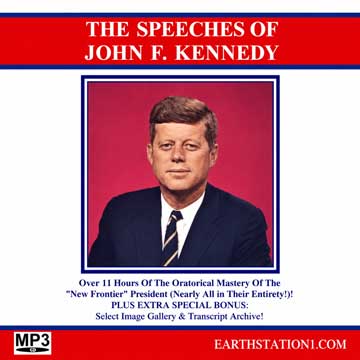
October 22, 1962: Cuba: The History Of
Cuba: The Aftermath Of World War II: The Cold War: The Cold War
(1962-1979): The Cuban Cold War: The Cuban Missile Crisis: The
Presidency Of John F. Kennedy: Addresses To The Nation: Oval
Office Addresses: The Oval Office Address Of October 22, 1962 (The
Cuban Missile Crisis Address): -- President John F. Kennedy
delivers an Oval Office Address on television, an Address To The
Nation to inform Americans of the existence of Soviet missiles in
Cuba. The President demanded their removal and announced a naval
"quarantine" of Cuba. Nuclear war between the United
States and the Soviet Union was at that point imminent, and it
remained so until six days later, when the Soviets announced via
Radio Moscow that they would remove the weapons. When President
Kennedy was informed of Soviet medium range R-12 Dvina theatre
ballistic missiles (NATO reporting name: SS-4 Sandal) and their
launch facilities having been installed in Cuba, he then convened
a meeting of the nine members of the National Security Council and
five other key advisers in a group that became known as the
Executive Committee of the National Security Council (EXCOMM).
After consultation with them, Kennedy ordered a naval blockade on
October 22 to prevent further missiles from reaching Cuba. The US
announced it would not permit offensive weapons to be delivered to
Cuba and demanded that the weapons already in Cuba be dismantled
and returned to the Soviet Union. After several days of tense and
dangerous negotiations, an agreement was reached between Kennedy
and Khrushchev. Publicly, the Soviets would dismantle their
offensive weapons in Cuba and return them to the Soviet Union,
subject to United Nations verification, in exchange for a US
public declaration and agreement to avoid invading Cuba again.
Secretly, the United States agreed that it would dismantle all
US-built Jupiter MRBMs, which had been deployed in Turkey against
the Soviet Union; there has been debate on whether or not Italy
was included in the agreement as well. When all offensive missiles
and Ilyushin Il-28 light bombers had been withdrawn from Cuba, the
blockade was formally ended on November 21, 1962. The negotiations
between the United States and the Soviet Union pointed out the
necessity of a quick, clear, and direct communication line between
the two Superpowers. As a result, the Moscow-Washington hotline
was established. A series of agreements later reduced US-Soviet
tensions for several years until both parties began to build their
nuclear arsenals even further. On Sale @ 15% Off Discount Till
Midnight PT!
https://store.earthstation1.com/the-speeches-of-president-john-f-kennedy-mp3-dv3.html
Today's
EarthStation1.com #OnThisDay Commemorative Memorial Title: Soup To
Nuts (1930) The Three Stooges Rube Goldberg DVD, Download, USB
Today, October 22, 2025 October 22: National Nut Day: -- An
annual observance that is NOT about the neighbor that lives down
the street or the co-worker who sings with their headphones on. It
is a food holiday celebrating a healthy and nutritious snack! Nuts
are a highly prized food and energy source and are a primary
source of nutrients for both humans and wildlife. Many of them are
used in cooking, eaten raw, sprouted, or roasted as a snack food,
and pressed for oil that is used in cookery and cosmetics. The
fats found in nuts, for the most part, are unsaturated fats,
including monounsaturated fats. Many nuts are excellent sources of
vitamins E and B2. They are also rich in protein, folate fiber,
and essential minerals such as magnesium, phosphorus, potassium,
copper, and selenium. Nuts are essential to animals, especially
those in temperate climates, as they store acorns and other nuts
during the autumn months to keep from starving during late fall,
all winter, and early spring. Several studies have shown that
those who consume nuts regularly are less likely to suffer from
coronary heart disease (CHD). It was in 1993 that nuts were first
linked to protection against CHD. Since that time, many clinical
trials have found that the consumption of various nuts, such as
almonds and walnuts, can lower serum LDL cholesterol
concentrations. One study has shown that people who ate nuts lived
two to three years longer than those who did not. Those who were
consuming nuts may have been eating less junk food leading to a
longer lifespan. Nuts in their raw form retain the most
nutritional benefit, too. However you celebrate the day, though,
be sure to enjoy snacking on your favorite nut! To celebrate
National Nut Day, have a snack consisting of raw nuts during the
day and try this Mixed Nut Bars recipe. Share your favorite
recipes or make some gorp. Stock up on your favorites and bring
nutty treats to share with everyone! Top some nuts on your salad
at lunch and use crush nuts to create a crust for a pie or even a
savory roast. And use #NationalNutDay to post on social media!
https://store.earthstation1.com/soup-to-nuts-dvd-three-stooges-rube-goldberg.html
October 22: National Nut Day: -- An
annual observance that is NOT about the neighbor that lives down
the street or the co-worker who sings with their headphones on. It
is a food holiday celebrating a healthy and nutritious snack! Nuts
are a highly prized food and energy source and are a primary
source of nutrients for both humans and wildlife. Many of them are
used in cooking, eaten raw, sprouted, or roasted as a snack food,
and pressed for oil that is used in cookery and cosmetics. The
fats found in nuts, for the most part, are unsaturated fats,
including monounsaturated fats. Many nuts are excellent sources of
vitamins E and B2. They are also rich in protein, folate fiber,
and essential minerals such as magnesium, phosphorus, potassium,
copper, and selenium. Nuts are essential to animals, especially
those in temperate climates, as they store acorns and other nuts
during the autumn months to keep from starving during late fall,
all winter, and early spring. Several studies have shown that
those who consume nuts regularly are less likely to suffer from
coronary heart disease (CHD). It was in 1993 that nuts were first
linked to protection against CHD. Since that time, many clinical
trials have found that the consumption of various nuts, such as
almonds and walnuts, can lower serum LDL cholesterol
concentrations. One study has shown that people who ate nuts lived
two to three years longer than those who did not. Those who were
consuming nuts may have been eating less junk food leading to a
longer lifespan. Nuts in their raw form retain the most
nutritional benefit, too. However you celebrate the day, though,
be sure to enjoy snacking on your favorite nut! To celebrate
National Nut Day, have a snack consisting of raw nuts during the
day and try this Mixed Nut Bars recipe. Share your favorite
recipes or make some gorp. Stock up on your favorites and bring
nutty treats to share with everyone! Top some nuts on your salad
at lunch and use crush nuts to create a crust for a pie or even a
savory roast. And use #NationalNutDay to post on social media!
https://store.earthstation1.com/soup-to-nuts-dvd-three-stooges-rube-goldberg.html
Today's
EarthStation1.com #OnThisDay Commemorative Memorial Title:
Challenge Of The Yukon Old Time Radio Series MP3 Set DVD Download
USB
Today, October 22, 2025October 22: National Make A Dog's Day: -
A holiday that invites dog-lovers everywhere to go the extra mile
for their pup! Today is a reminder to animal lovers everywhere to
adopt a pet instead of buying a new one. In fact, we encourage
everyone to visit a shelter to see why adopting a four-legged
friend will make the world a better place. Why should I adopt a
pet? Approximately 3.1 million dogs enter shelters in the United
States annually, many being relinquished by their owners. Worse
still, approximately 15% of the animals that enter shelters are
euthanized. While numbers continue to decline, the need for
adoption continues to be overwhelming. One sure way to make a
dog's day is giving them a new, loving home through adoption. When
you adopt a pet, you are: Saving a life; Stopping animal cruelty
in breeding facilities; Saving money for spaying, neutering,
vaccination and sometimes microchipping; Choosing from a large
selection of dog breed who are normally house-trained; Adopting a
dog who has received excellent care in the shelter, which means
they are healthy; Adoption is just one way to make a dog's day. If
your favorite canine companion could talk, they might tell us
going for an extra-long walk would make their day. When was the
last time you visited the dog park? Of course, a new chew toy
might top their list. Sometimes, they just want to play. Throw the
ball already! Another thing that tops the list of fur babies
everywhere - don't stop scratching that itch. How do I care for my
newly adopted dog? When you adopt a dog from a shelter, the
amazing staff guide you in caring for your new furry companion.
Keeping your dog healthy is an act of unspoken love between you
and your pup. Normally, a shelter will provide services before you
leave. However, if they haven't, you should! Schedule regular
check-ups for your dog with your veterinarian. Choose a schedule
that fits you and your new animal friend. Vaccinate your dog
according to what they need. Your veterinarian will make the
correct recommendations to help you decide important vaccinations.
Spay or neuter your pet. Beyond the health benefits, unplanned
puppies cause the population in shelters to increase. Visit a
shelter, find your loyal canine companion, and make a dog's day
through adoption! Volunteer at a shelter by taking a dog for a
walk or bringing them a new chew toy. Donate new blankets, treats,
or other supplies to a shelter. You can check your local shelter
needs by visiting their website or simply making a call. If you're
already the owner of a beloved dog, take the extra time to make
your dog's day. Repay that unconditional love with creative tokens
of dog-gone appreciation. Shelters: make sure to share your
adoption events by posting your stories and photos using the
hashtag #MakeADogsDay on social media. Subaru invites dog owners
to do something special for the furry friends in their lives and
share on social media using #MakeADogsDay. For those who are yet
to be pet parents, Subaru invites Americans to consider adopting a
shelter pet or "Underdog." In 2019, Subaru founded
National Make A Dog's Day to raise awareness for pet adoption.
With the help of National Day Calendar, they set out to show the
world just how good it feels to make a dog's day. Since its
launch, #MakeADogsDay has reached 68 million people and helped
find homes for nearly 60,000 dogs.
https://store.earthstation1.com/challenge-of-the-yukon-mp3-dvd-complete-radio-broadcast3.html
Today's
EarthStation1.com #OnThisDay Commemorative Memorial Title: Vincent
van Gogh: An Explosion Of Colors DVD, Download, USB Drive
Today, October 22, 2025October 22: National Color Day: -- Today
gives you a chance to stop and reflect on the relationship we
share with the colors that surround us and the innumerable ways in
which they impact us. How long has it been since you stopped by a
garden to admire a yellow sunflower, or gazed at the deep blue
sky? We invite you to celebrate the power of colors today!
National Color Day celebrates and enlightens people about the
significance attached to each color. Humans have always shared a
deep relationship with the colors that surround them. As we grow
up, our tastes evolve and so does our association with the things
that we once liked. But this omnipresent element of nature hardly
gets its due recognition. National Color Day is celebrated to
recognize the duality of our relationship with colors. We often
use colors to our benefit but we seldom talk about the power and
influence that our chosen color has on our mood, state of mind,
and attention span. The right color can enhance your beauty and
the wrong one can ruin a photograph. Our brains associate colors
with memories and shape our experiences of melancholy and trauma.
Much of the impact that a color can have on us is based on our
biology, and then there's our personal relationship with colors.
The advertising industry reaps great benefits from the color
theory, which illustrates our predisposition to some colors. For
example, a combination of red and yellow can stimulate our brain -
a concept that reflects on the logos of McDonald's, Netflix, KFC,
and Target. Launched by General Motors in 2009 as a part of a
promotion for a brand new Chevrolet, National Color Day has been
celebrated ever since.
https://store.earthstation1.com/vincent-van-gogh-an-explosion-of-colors-dvd.html
Today's
EarthStation1.com #OnThisDay Commemorative Memorial Title: Paul
Cezanne & The Riddle Of The Great Bathers MP4 Video Download
DVD
Today, October 22, 2025October 22, 1906: #DOTD: #RIP: Paul
Cezanne, French artist and Post-Impressionist painter whose work
introduced new modes of representation and influenced avant garde
artistic movements of the early 20th century (b. January 19, 1839)
#dies of pneumonia in his hometown of Aix-en-Provence, France at
the age of 67, and is buried there at the Saint-Pierre Cemetery.
Paul Cezanne was born the son of the milliner and later banker
Louis-Auguste Cezanne and Anne-Elisabeth-Honorine Aubert at 28 rue
de l'Opera. Cezanne is said to have formed the bridge between late
19th-century Impressionism and the early 20th century's new line
of artistic enquiry, Cubism. While his early works are still
influenced by Romanticism - such as the murals in the Jas de
Bouffan country house - and Realism, Cezanne arrived at a new
pictorial language through intensive examination of Impressionist
forms of expression. He altered conventional approaches to
perspective and broke established rules of academic art by
emphasizing the underlying structure of objects in a composition
and the formal qualities of art. Cezanne strived for a renewal of
traditional design methods on the basis of the impressionistic
colour space and colour modulation principles. Cezanne's often
repetitive, exploratory brushstrokes are highly characteristic and
clearly recognizable. He used planes of colour and small
brushstrokes that build up to form complex fields. The paintings
convey Cezanne's intense study of his subjects. Both Henri Matisse
and Pablo Picasso are said to have remarked that Cezanne "is
the father of us all". His painting provoked incomprehension
and ridicule in contemporary art criticism. Until the late 1890s
it was mainly fellow artists such as Camille Pissarro and the art
dealer and gallery owner Ambroise Vollard who discovered Cezanne's
work and were among the first to buy his paintings. In 1895,
Vollard opened the first solo exhibition in his Paris gallery,
which led to a broader examination of the artist's work.
https://store.earthstation1.com/paul-cezanne-amp-the-riddle-of-the-great-bathers-mp4-video-download-dv4.html
Today's
EarthStation1.com #OnThisDay Commemorative Memorial Title: The
American Adventure: TV History Series 1607-1876 DVD MP4 USB Drive
Today, October 22, 2025October 22, 1836: Texas: The History Of
Texas: The Republic Of Texas: The History Of The Republic Of
Texas: Inaugurations: The Inauguration Of Sam Houston As President
Of The Republic Of Texas:-- Sam Houston, American soldier and
politician, is inaugurated as the first President Of The Republic
Of Texas. ========= Sam Houston (March 2, 1793 - July 26, 1863)
was born Samuel Houston at Timber Ridge Plantation in Rockbridge
County, Virginia. He was of Scots-Irish descent. After moving to
Tennessee after his father died, he spent time with the Cherokee
Nation, into which he later was adopted as a citizen and into
which he married. He performed military service during the War Of
1812 and successfully participated in Tennessee politics. In 1827,
Houston was elected Governor of Tennessee as a Jacksonian. In
1829, he resigned as governor and relocated to the Arkansas
Territory. In 1832, Houston was involved in an altercation with a
U.S. Congressman, followed by a high-profile trial. Shortly
afterwards, he moved west to Coahuila y Tejas, then a Mexican
state, and became a leader of the Texas Revolution. His victory at
the Battle of San Jacinto, fought on April 21, 1836, the decisive
battle of the Texas Revolution between General Houston's Texian
Army General Santa Anna's Mexican army that lasted just 18
minutes, secured the independence of Texas from Mexico in one of
the shortest decisive battles in modern history. After the war,
Houston became a key figure in Texas and was elected as the first
and third President of the Republic of Texas. He supported
annexation by the United States and he became a U.S. Senator upon
achieving it in 1845, and finally a governor of the State of Texas
in 1859, whereby Houston became the only person to have become the
governor of two different U.S. states through popular election, as
well as the only state governor to have been a foreign head of
state. He was also the only governor within a future Confederate
state to oppose secession, which led to the outbreak of the
American Civil War, and to refuse an oath of allegiance to the
Confederacy, a decision that led to his removal from office by the
Texas secession convention. To avoid bloodshed, he refused an
offer of a Union army to put down the Confederate rebellion.
Instead, he retired to Huntsville, Texas, where he died before the
end of the war. Houston's name has been honored in numerous ways.
He is the namesake of the city of Houston, Texas's most populous
city and the fourth most populous city in the U.S. Other things
named for Sam Houston include Sam Houston State University, a
memorial museum, the USS Sam Houston (SSBN-609) naval vessel, Fort
Sam Houston, Sam Houston National Forest, a historical park, an
elementary school in Lebanon, Tennessee (Sam Houston Elementary),
a prominent roadside statue outside of Huntsville, and major
streets in many Texas cities. ========= The Republic of Texas
(Spanish: Republica de Tejas) was a sovereign state in North
America that existed from March 2, 1836, to February 19, 1846. It
shared borders with Mexico, the Republic of the Rio Grande
(another Mexican breakaway republic), and the United States of
America. Mexico considered it a rebellious province during its
entire existence. It was bordered by Mexico to the west and
southwest, the Gulf of Mexico to the southeast, the two U.S.
states of Louisiana and Arkansas to the east and northeast, and
United States territories encompassing parts of the current U.S.
states of Oklahoma, Kansas, Colorado, Wyoming, and New Mexico to
the north and west. The Anglo residents of the area and of the
republic were referred to as Texians. The Mexican state of
Coahuila y Tejas declared its independence from Mexico during the
Texas Revolution in 1835-1836, when the Centralist Republic of
Mexico abolished autonomy from states of the Mexican federal
republic. Major fighting ended on April 21, 1836, but the Mexican
Congress refused to recognize the independence of the Republic of
Texas, as the Treaties of Velasco was signed by Mexican President
General Antonio Lopez de Santa Anna under duress as prisoner of
the Texians, and the majority of the Mexican Congress did not
approve the agreement. Intermittent conflicts between Mexico and
Texas continued into the 1840s. The United States recognized the
Republic of Texas in March 1837 but declined to annex the
territory at that time. The Republic of Texas claimed borders
based upon the Treaties of Velasco between the newly-created
Republic of Texas and General Santa Anna. The eastern boundary had
been defined by the Adams-Onis Treaty of 1819 between the United
States and the Spanish Empire, which recognized the Sabine River
as the eastern boundary of Spanish Texas and western boundary of
the Missouri Territory. Under that treaty, the United States had
renounced its claim to Spanish land to the east of the Rocky
Mountains and to the north of the Rio Grande, which it claimed to
have acquired as part of the Louisiana Purchase of 1803. The
southern and western boundary of the Republic of Texas with Mexico
was disputed throughout the republic's existence, since Mexico
refused to acknowlege the independence of Texas. Texas claimed the
Rio Grande as its southern boundary, while Mexico insisted that
the Nueces River was the boundary. In practice, much of the
disputed territory was occupied by the Comanche and outside the
control of either state, but Texian claims included the eastern
portions of New Mexico, which was administered by Mexico
throughout this period. Texas was annexed by the United States on
December 29, 1845, and was admitted to the Union as the 28th state
on that day, with the transfer of power from the Republic to the
new state of Texas formally taking place on February 19, 1846.
However, the United States inherited the southern and western
border-disputes with Mexico, which had refused to recognize
Texas's independence or to accept U.S. offers to purchase the
territory. Consequently, the annexation led to the
Mexican-American War (1846-1848).
https://store.earthstation1.com/the-american-adventure-series-us-1st-century-4-dv14.html
Today's
EarthStation1.com #OnThisDay Commemorative Memorial Title: Stooge
Snapshots Documentary On Three Stooges DVD, Video Download, USB
Today, October 22, 2025October 22, 1903: #BOTD: #HBD! Curly
Howard, American comedian and vaudevillian actor, best known as a
member of the American farce comedy team the Three Stooges, which
also featured his older brothers Moe and Shemp Howard and actor
Larry Fine, who despite being an untrained actor was generally
considered the most popular and recognizable of the Stooges (d.
January 18, 1952) is #born Yehudah Leib bar Shlomo Natan HaLevi in
the Bensonhurst section of the Brooklyn borough of New York City
into a Lithuanian Jewish family, the youngest of the five sons of
Jennie (Gorovitz) and Solomon Horwitz; because he was the
youngest, his brothers called him "Babe" to tease him.
Jerome Lester "Jerry" Horwitz was well known for his
high-pitched voice and vocal expressions ("nyuk-nyuk-nyuk!",
"woob-woob-woob!", "soitenly!" (certainly),
and barking like a dog) as well as his physical comedy (e.g.,
falling on ground and pivoting on his shoulder as he "walked"
in circular motion), improvisations, and athleticism. Curly was
forced to leave the Three Stooges act in 1946 when a massive
stroke ended his showbusiness career. He suffered through serious
health problems and several more strokes until his death after a
long series of strokes at Baldy View Sanitarium in San Gabriel,
California, having lived the shortest life of the Stooges, dying
at the age of 48. He was given a Jewish funeral and was buried at
the Western Jewish Institute section of Home of Peace Cemetery in
East Los Angeles. His older brothers, Benjamin and Shemp (who died
three years later), and parents Jennie and Solomon are all
interred there as well.
https://store.earthstation1.com/stooge-snapshots-dvd-three-stooges-documentary.html
Today's
EarthStation1.com #OnThisDay Commemorative Memorial Title: The
Soupy Sales TV Shows Video MegaSet DVD, MP4 Download, USB Stick
Today, October 22, 2025October 22, 2009: #DOTD: #RIP: Soupy
Sales, American comedian, actor, radio/television personality and
jazz aficionado, best known for his local and network children's
television show, Lunch with Soupy Sales (1953-1966), a series of
comedy sketches frequently ending with Sales receiving a pie in
the face, which became his trademark (b. January 8, 1926) #dies at
Calvary Hospice in Bronx, New York, aged 83, from cancer. He is
buried at Kensico Cemetery in Valhalla, New York. Soupy Sales was
born Milton Supman into a Jewish family in Franklinton, North
Carolina. Soupy Sales also starred in the 1966 movie Birds Do It.
From 1968 to 1975, he was a regular panelist on the syndicated
revival of What' My Line? and appeared on several other TV game
shows. During the 1980s, Sales hosted his own show on WNBC-AM in
New York City.
https://store.earthstation1.com/lost-soupy-sales-tv-shows-dvd.html
Today's
EarthStation1.com #OnThisDay Commemorative Memorial Title:
Breaking The Code 1996 Alan Turing Derek Jacobi MP4 Video Download
DVD
Today, October 22, 2025October 22, 1938: #BOTD: #HBD! Derek
Jacobi, English actor and stage director, is #born Derek George
Jacobi in Leytonstone, Essex, England. Sir Derek George Jacobi CBE
has had a successful stage career appearing in such stage
productions as Hamlet, Uncle Vanya, and Oedipus the King. He has
twice been awarded a Laurence Olivier Award, first for his
performance of the eponymous hero in Cyrano De Bergerac in 1983
and the second for his Malvolio in Twelfth Night in 2009. He also
received a Tony Award for his performance in Much Ado About
Nothing in 1984 and a Primetime Emmy Award in 1988 for The Tenth
Man. His stage work includes playing Octavius Caesar, Edward II,
Richard III and Thomas Becket. In addition to being a founder
member of the Royal National Theatre and winning several
prestigious theatre awards, Jacobi has also had a successful
television career, starring in the iconic, critically praised and
popular adaptation of Robert Graves's I, Claudius (1976), for
which he won a BAFTA; as a voice over artist in the documentary
series The Romantic Spirit (1983); in the titular role in the
medieval drama series Cadfael (1994-1998), as Stanley Baldwin in
The Gathering Storm (2002), as Stuart Bixby in the ITV comedy
Vicious (2013-2016) and as Alan Buttershaw in Last Tango in
Halifax (2012-2016). Jacobi also portrayed a version of the Master
in the long running science fiction series Doctor Who. Though
principally a stage actor, Jacobi has appeared in a number of
films, including The Day of the Jackal (1973), Henry V (1989),
Dead Again (1991), Gladiator (2000), Gosford Park (2001), The
Riddle (2007), The King's Speech (2010), My Week with Marilyn
(2011), Cinderella (2015), and Murder on the Orient Express
(2017). He was knighted in 1994 and has also been made a member of
The Danish Order Of The Dannebrog.
https://store.earthstation1.com/breaking-the-code-1996-alan-turing-derek-jacobi-mp4-video-downloa19964.html
Today's
EarthStation1.com #OnThisDay Commemorative Memorial Title: Ernie
Kovacs: Between The Laughter (1984) DVD, MP4 Download, USB Drive
Today, October 22, 2025October 22, 1952: #BOTD: #HBD! Jeff
Goldblum, American actor, producer and musician, is #born Jeffrey
Lynn Goldblum into a Jewish family in West Homestead,
Pennsylvania. He has starred in some of the highest-grossing films
of his era, such as Jurassic Park (1993) and Independence Day
(1996), as well as their respective sequels, The Lost World:
Jurassic Park (1997) and Jurassic World: Fallen Kingdom (2018),
and Independence Day: Resurgence (2016). Goldblum also starred in
films including Invasion of the Body Snatchers (1978), The Big
Chill (1983), and Into the Night (1985), before coming to wider
attention in David Cronenberg's The Fly (1986), which earned him a
Saturn Award for Best Actor. His other films include The
Adventures of Buckaroo Banzai Across the 8th Dimension (1984), The
Tall Guy (1989), Deep Cover (1992), Powder (1995), The Prince of
Egypt (1998), Cats & Dogs (2001), Igby Goes Down (2002), The
Life Aquatic with Steve Zissou (2004), Adam Resurrected (2008), Le
Week-End (2013), The Grand Budapest Hotel (2014), and Thor:
Ragnarok (2017). Goldblum starred in the TV docudrama Ernie
Kovacs: Between The Laughter (1984). He has also starred in
several TV series, including the eighth and ninth seasons of Law &
Order: Criminal Intent as Zack Nichols. He directed the short film
Little Surprises, which was nominated for the Academy Award for
Best Live Action Short Film.
https://store.earthstation1.com/ernie-kovacs-between-the-laughter-dvd-jeff-goldblum-tv-movie.html
Today's
EarthStation1.com #OnThisDay Commemorative Memorial Title: War
Reporters: Armed Conflict News Reporters DVD, Download, USB Drive
Today, October 22, 2025October 22, 1913: #BOTD: #HBD! Robert
Capa, Hungarian-American war photographer and photo journalist,
arguably the greatest combat and adventure photographer in history
(d. May 25, 1954) is #born Endre Friedmann in Budapest,
Austria-Hungary. Robert Capa fled political repression in Hungary
when he was a teenager, moving to Berlin, where he enrolled in
college. He witnessed the rise of Hitler, which led him to move to
Paris, where he changed his name and became a photojournalist. He
subsequently covered five wars: the Spanish Civil War, the Second
Sino-Japanese War, World War II across Europe, the 1948
Arab-Israeli War, and the First Indochina War, with his photos
published in major magazines and newspapers. During his career he
risked his life numerous times, most dramatically as the only
civilian photographer landing on Omaha Beach on D-Day. He
documented the course of World War II in London, North Africa,
Italy, and the liberation of Paris. His friends and colleagues
included Irwin Shaw, John Steinbeck, Ernest Hemingway and director
John Huston. In 1947, for his work recording World War II in
pictures, U.S. general Dwight D. Eisenhower awarded Capa the Medal
Of Freedom. That same year, Capa co-founded Magnum Photos in
Paris. The organization was the first cooperative agency for
worldwide freelance photographers. While in Japan in the early
1950s, Life magazine asked him to go on assignment to Southeast
Asia, where the French had been fighting for eight years in the
First Indochina War, where he died aged 40 after he stepped on a
land mine in Thai Binh, Vietnam. He is buried in Amawalk Friends
Cemetery in Amawalk, Westchester County, New York.
https://store.earthstation1.com/war-reporters-dvd-news-correspondents-covering-armed-conflict.html
Today's
EarthStation1.com #OnThisDay Commemorative Memorial Title: Birth
Of A Nation (1915) D. W. Griffith DVD, MP4 Download, USB Stick
Today, October 22, 2025October 22, 1906: The Nadir Of American
Race Relations (1877/1890 - 1901/1923/1941 [Dates Disputed]):
Discrimination: White Supremacy: The Ku Klux Klan (KKK):
Pseudohistory: The Lost Cause Of The Confederacy (The Lost Cause,
The Lost Cause Myth): The Clansman: A Historical Romance Of The Ku
Klux Klan: The 1906 Philadelphia Clansman Performance Protest Riot
-- After a coalition of three thousand African American men
demonstrate and riot during a public protest in front of the
Walnut Street Theatre in Philadelphia, where a theatrical
presentation of Thomas Dixon's The Clansman was to be performed,
the matter ends up in City Hall at a hearing before Philadelphia
Mayor John Weaver. Mayor Weaver rebuked the protesters, but he
ultimately stopped the play being performed. The Philadelphia
Inquirer ran such stories as "Race Riot Caused by a Press
Agent" on October 24, 1906 and "Clansman Causes Strike"
on October 25. This ruckus should have informed D.W. Griffith's
decision to make his 1915 silent epic drama based on Dixon's play,
The Birth Of A Nation, but it did not, and the film ultimately
resulted in resurrecting the Ku Klux Klan (KKK) from the hell it
should have been left in. The Clansman: A Historical Romance Of
The Ku Klux Klan is a novel published in 1905, the second work in
the Ku Klux Klan trilogy by Thomas Dixon Jr. (the others are The
Leopard's Spots and The Traitor). Chronicling the American Civil
War and Reconstruction era from a pro-Confederate perspective, it
presents the Ku Klux Klan heroically. Thomas Frederick Dixon Jr.
(January 11, 1864 - April 3, 1946) was an American white
supremacist, Baptist minister, politician, lawyer, lecturer,
novelist, playwright, and filmmaker. Referred to as a
"professional racist", Dixon wrote two best-selling
novels, The Leopard's Spots: A Romance of the White Man's
Burden-1865-1900 (1902) and The Clansman: A Historical Romance of
the Ku Klux Klan (1905), that romanticized Southern white
supremacy, endorsed the Lost Cause of the Confederacy, opposed
equal rights for black people, and glorified the Ku Klux Klan as
heroic vigilantes.
https://store.earthstation1.com/birth-of-a-nation-dvd-d-w-griffith-civil-war-movie.html
Today's
EarthStation1.com #OnThisDay Commemorative Memorial Title: Daley:
The Last Boss: Chicago Mayor Richard J. Daley MP4 Download DVD
Today, October 22, 2025October 22, 1963: Civil Rights Movements:
The American Civil Rights Movement (1954-1968): School
Desegregation: The Desegregation Of Chicago Public Schools: The
Chicago Public Schools Boycott (Freedom Day): -- A mass boycott
and demonstration by approximately 225,000 students protest the
segregationist policies of the Chicago Public Schools (CPS). More
than 200,000 students stayed out of school, and tens of thousands
of Chicagoans joined in a protest that culminated in a march to
the office of the Chicago Board of Education. The protest preceded
the even larger New York City public school boycott, also known as
Freedom Day. Although Brown v. Board of Education prohibited
racial segregation in schools, in 1963, Chicago's public schools
continued to be segregated as a result of residential segregation.
This was exacerbated by the migration of more black Americans from
the Southern United States to Chicago during the Jim Crow era.
School boundary lines were drawn specifically to preserve racial
segregation, even as predominantly black schools grew overcrowded.
Classes were held in hallways, and there were not enough books for
all of the students. Some schools held double shifts, meaning
students attended less than a full day of class. Rather than send
black students to underpopulated white schools, Superintendent of
Chicago Public Schools Benjamin Willis instituted the use of
mobile classrooms; 625 aluminium trailers parked in the parking
lots and playgrounds of overcrowded schools. Rosie Simpson of
Englewood, Chicago, coined the term "Willis Wagons" to
describe the mobile classrooms. At one high school, these trailers
were used to maintain segregation within the school; black
students' classes were held in Willis Wagons, while only white
students went to class in the school. In response to the school
segregation enacted by Willis, community members began organizing
resistance. Organizers included Chicago activist Albert Raby. The
Coordinating Council of Community Organizations (CCCO) took the
lead, organizing "Freedom Day," the mass boycott and
protest. According to the chairman of the CCCO, Lawrence Landry,
"The boycott is an effort to communicate dissatisfaction on
how schools are being run." The Chicago Defender estimated
that forty percent of CPS students would participate in the
boycott. On October 22, 1963, nearly half of all CPS students
skipped school, leaving schools on Chicago's South Side and West
Side mostly empty. The Chicago Tribune reported that 224,770
students were absent from CPS, amounting to 47 percent of the
student population. Some students opted to attend makeshift
Freedom Schools instead. In addition to the boycott, nearly 10,000
protesters marched in Chicago's downtown, stopping outside the
Chicago Board of Education offices. Chicago police kept protesters
from entering the building. While Freedom Day was popular and
widely covered, it did not have significant impact in changing the
policies of Superintendent Willis. This de facto school
segregation was supported by da Mayor Richard J. Daley, who went
on to nominate two school board members who did not support the
CCCO's push for integration. Ultimately, CPS was not moved to
integrate after Freedom Day, despite the best efforts of Black
activists and the CCCO. Use of Willis Wagons prevailed, and Willis
himself did not retire until 1966 (albeit four months before the
end of his term). However, the size of the first Freedom Day
protest inspired subsequent boycotts in Chicago and the United
States. The Freedom Day protest inspired Reverend Martin Luther
King Jr.'s move to Chicago in 1966. Before Freedom Day, in August,
1963, then-college student Bernie Sanders was arrested while
protesting the policies of Superintendent Willis.
https://store.earthstation1.com/dalabochmari.html
Today's
EarthStation1.com #OnThisDay Commemorative Memorial Title:
Conspiracy The Trial Of The Chicago 8 + Yippie For Pigasus DVD MP4
USB
Today, October 22, 2025October 22, 1936: #BOTD: #HBD! Bobby
Seale, African American political and civil rights activist and
author, is #born Robert George Seale in Liberty, Texas. Seale is
widely known for co-founding the Black Panther Party with fellow
activist Huey P. Newton. Founded as the "Black Panther Party
for Self-Defense", the Party's main practice was monitoring
police activities and challenging police brutality in Black
communities, first in Oakland, California, and later in cities
throughout the United States. Seale was one of the eight people
charged by the US federal government with conspiracy charges
related to anti-Vietnam War protests in Chicago, Illinois, during
the 1968 Democratic National Convention. Seale's appearance in the
trial was widely publicized and Seale was bound and gagged for his
appearances in court more than a month into the trial for what
Judge Julius Hoffman said were disruptions. Seale's case was
severed from the other defendants, turning the "Chicago
Eight" into the "Chicago Seven". After his case was
severed, the government declined to retry him on the conspiracy
charges. Though he was never convicted in the case, Seale was
sentenced by Judge Hoffman to four years for criminal contempt of
court. The contempt sentence was reversed on appeal. In 1970,
while in prison, Seale was charged and tried as part of the New
Haven Black Panther trials over the torture and murder of Alex
Rackley. The Black Panther Party suspected him of being a police
informer. Panther George Sams, Jr., testified that Seale had
ordered him to kill Rackley. The jury was unable to reach a
verdict in Seale's trial, and the charges were eventually dropped.
Seale's books include A Lonely Rage: The Autobiography of Bobby
Seale, Seize the Time: The Story of the Black Panther Party and
Huey P. Newton, and Power to the People: The World of the Black
Panthers (with Stephen Shames).
https://store.earthstation1.com/conspiracy-the-trial-of-the-chicago-8-dvd-1987-tv-docu81987.html
Today's
EarthStation1.com #OnThisDay Commemorative Memorial Title: The
Great Depression 7 Part Documentary Series MP4 Video Download DVD
Today, October 22, 2025October 22, 1934: #DOTD: Pretty Boy
Floyd, a Robin Hood-like bank robber but nevertheless notorious
killer who operated in the Midwest and West South Central States,
and whose criminal exploits gained widespread press coverage in
the early Great Depression days of the 1930s (b. February 3, 1904)
#dies when Federal Bureau Of Investigation (FBI) agents shoot and
kill him in East Liverpool, Ohio, aged 30. Floyd's body was
embalmed and briefly viewed at the Sturgis Funeral Home in East
Liverpool, Ohio, before being sent on to Oklahoma. His body was
placed on public display in Sallisaw, Oklahoma. His funeral was
attended by between 20,000 and 40,000 people and remains the
largest funeral in Oklahoma history. He was buried in Akins
Cemetery in Akins, Oklahoma. Pretty Boy Floyd was born Charles
Arthur in Bartow County, Georgia. Following the death of John
Dillinger on July 22, 1934, Pretty Boy Floyd was named Public
Enemy No. 1. Like several other prominent outlaws of that era, he
was pursued and killed by a group led by Melvin Purvis. Historians
have speculated as to which officers were at the event, local or
the FBI: known accounts document that local officers Robert "Pete"
Pyle and George Curran were present at his fatal shooting and also
at his embalming. Floyd has continued to be a familiar figure in
American popular culture, sometimes seen as notorious, but also at
other times viewed as a tragic figure, partly a victim of the hard
times of the Great Depression in the United States.
https://store.earthstation1.com/grde7padosem.html
Today's
EarthStation1.com #OnThisDay Commemorative Memorial Title: The
Twentieth Century With Walter Cronkite TV Series DVD MP4 USB Drive
Today, October 22, 2025October 22, 1944: World War II: The
Pacific War (The Asia-Pacific War, The Asiatic-Pacific Theater,
The Pacific Theater Of World War II): The Pacific Ocean Theater Of
World War II: The Southwest Pacific Theater Of World War II: The
Philippines Campaign (1944-1945) (Battle Of The Philippines,
Second Philippines Campaign, The Liberation Of The Philippines,
Operation Musketeer I, II, and III): The Battle Of Leyte
(Codename: King Two; Filipino: Labanan Sa Leyte; Waray: Gubat Ha
Leyte; Japanese: Reite No Tatakai) -- The 1st Cavalry Division of
Maj. Gen. Verne D. Mudge secures Hill 215 the day after securing
Leyte province's provincial capital of Tacloban. As a result of
this victories, Gen. MacArthur on the following day, October 23,
presided over a ceremony to restore civil government to Leyte. 1st
and 2nd Cavalry Brigades initiated a holding action to prevent a
Japanese counterattack from the mountainous interior, after which
the 1st Cavalry was allowed to move on. The Battle Of Leyte
(Filipino: Labanan sa Leyte; Waray: Gubat ha Leyte; Japanese:
Reite No Tatakai) in the Pacific campaign of World War II was the
amphibious invasion of the island of Leyte in the Philippines by
American forces and Filipino guerrillas under the overall command
of General Douglas MacArthur, who fought against the Imperial
Japanese Army in the Philippines led by General Tomoyuki
Yamashita. The operation, codenamed King Two, launched the
Philippines Campaign of 1944-45 for the recapture and liberation
of the entire Philippine Archipelago and to end almost three years
of Japanese occupation.
https://store.earthstation1.com/the-twentieth-century-with-walter-cronkite-5-dual-layer-dvd5.html
Today's
EarthStation1.com #OnThisDay Commemorative Memorial Title: War
Jets: The Republic F-105 Thunderchief DVD, MP4 Download, USB Drive
Today, October 22, 2025October 22, 1955: Maiden Flights: --
First flight of the Republic F-105 Thunderchief occurs as its
YF-105A prototype takes to the air; a second YF-105A flew the
following January 28. In spite of being powered by a less potent
J57-P-25 engine with 15,000 pounds-force (67 kN) of afterburning
thrust, this first prototype attained the speed of Mach 1.2 on its
maiden flight. (The J75 was expected to generate 24,500 lbf (109
kN) with afterburner.) Both aircraft featured conventional wing
root air intakes and slab-sided fuselages typical of the early
jets; however, Republic viewed these prototypes as not being
representative of the true capability of the aircraft in the form
it would ultimately take. The Republic F-105 Thunderchief is an
American supersonic fighter-bomber used by the United States Air
Force. Capable of Mach 2, it conducted the majority of strike
bombing missions during the early years of the Vietnam War; it was
the only American aircraft to have been removed from combat due to
high loss rates. It was originally designed as a single-seat,
nuclear-attack aircraft; a two-seat Wild Weasel version was later
developed for the specialized Suppression of Enemy Air Defenses
(SEAD) role against surface-to-air missile sites. The F-105 was
commonly known as the "Thud" by its crews. As a
follow-on to the Mach 1 capable North American F-100 Super Sabre,
the F-105 was also armed with missiles and a rotary cannon;
however, its design was tailored to high-speed low-altitude
penetration carrying a single nuclear weapon internally. First
flown in 1955, the Thunderchief entered service in 1958. The
single-engine F-105 could deliver a bomb load greater than some
American heavy bombers of World War II such as the Boeing B-17
Flying Fortress and Consolidated B-24 Liberator. The F-105 was one
of the primary attack aircraft of the Vietnam War; over 20,000
Thunderchief sorties were flown, with 382 aircraft lost including
62 operational (non-combat) losses (out of the 833 produced).
Although less agile than smaller MiG fighters, USAF F-105s were
credited with 27.5 kills. During the war, the single-seat F-105D
was the primary aircraft delivering heavy bomb loads against the
various military targets. Meanwhile, the two-seat F-105F and
F-105G Wild Weasel variants became the first dedicated SEAD
platforms, fighting against the Soviet-built S-75 Dvina (NATO
reporting name: SA-2 Guideline) surface-to-air missiles. Two Wild
Weasel pilots were awarded the Medal Of Honor for attacking North
Vietnamese surface-to-air missile sites, with one shooting down
two MiG-17s the same day. The dangerous missions often required
them to be the "first in, last out", suppressing enemy
air defenses while strike aircraft accomplished their missions and
then left the area. When the Thunderchief entered service it was
the largest single-seat, single-engine combat aircraft in history,
weighing approximately 50,000 pounds (23,000 kg). It could exceed
the speed of sound at sea level and reach Mach 2 at high altitude.
The F-105 could carry up to 14,000 lb (6,400 kg) of bombs and
missiles. The Thunderchief was later replaced as a strike aircraft
over North Vietnam by both the McDonnell Douglas F-4 Phantom II
and the swing-wing General Dynamics F-111 Aardvark. However, the
"Wild Weasel" variants of the F-105 remained in service
until 1984 after being replaced by the specialized F-4G "Wild
Weasel V".
https://store.earthstation1.com/war-jets-the-republic-f105-thunderchief-105.html
Today's
EarthStation1.com #OnThisDay Commemorative Memorial Title: War
Props: The Messerschmitt Bf 109 DVD, MP4 Download, USB Flash Drive
Today, October 22, 2025October 22, 1942: The European Civil War:
World War II: The Second European War (The European Theater Of
World War II): The Eastern Front Of World War II: The Great
Patriotic War (The German-Soviet War): Aviation: Military
Aviation: Air Warfare Of World War II: -- Gunther Rall, highly
decorated German military aviator, fighter ace, officer and
general and pilot, third most successful fighter pilot in aviation
history whose military career spanned nearly forty years, claims
100 aerial combat victories and receives the Knight's Cross with
Oak Leaves. Gunther Rall (Anglicized: Guenther Rall; 1918-2009)
claimed all of his victories during the course of the war in a
Messerschmitt Bf 109, though he also flew the Focke-Wulf Fw 190
operationally. All but three of his entire wartime claims were
against Soviet opposition. His fighter successes were exceeded
only by Gerhard Barkhorn ("Gerd"), who ranks second, and
Erich Hartmann ("The Black Devil", "Bubi"),
who ranks first. During World War II Rall was credited with the
destruction of 275 enemy aircraft in 621 combat missions. He was
shot down five times and wounded on three occasions. Rall was born
in Gaggenau, the German Empire, and grew up in the Weimar
Republic; he died at his home in Bad Reichenhall after suffering a
heart attack two days earlier. In 1933 the Nazi Party seized power
and Rall, deciding upon a military career, joined the Wehrmacht
(Nazi German Armed Forces) in 1936 to train as an infantry
soldier. Rall transferred to the Luftwaffe soon after and he
qualified as a fighter pilot in 1938. In September 1939 World War
II began with the German Invasion Of Poland. Rall was assigned to
Jagdgeschwader 52 (JG 52-Fighter Wing 52) and flew combat patrols
in the Phoney War period on the Western Front. Rall flew combat
missions in the Battle Of France and Battle Of Britain, claiming
one enemy aircraft destroyed in May 1940. Rall's wing sustained
heavy casualties, and as a result the then-22 year old was
appointed to Staffelkapitan (Squadron Leader). He then served in
the Balkans Campaign in April and May 1941 without success. In
June 1941, JG 52 moved to the Eastern Front, where it remained
from Operation Barbarossa until the end of the war. Rall claimed
his first successes in the air defence of Romania. In November
1941, he was shot down, wounded and invalidated from flying for a
year. At this time Rall had claimed 36 aerial victories. His
achievements earned him the German Cross in Gold in December 1941.
Rall returned in August 1942 and was awarded the Knight's Cross on
September 3, 1942 for 65 enemy aircraft shot down. By October 22
Rall had claimed 100 and received the Knight's Cross with Oak
Leaves. He reached 200 in late August 1943. On September 12, 1943
he was awarded the Knight's Cross of the Iron Cross with Oak
Leaves and Swords, the second highest military award in the Third
Reich at the time of the presentation. By the end of 1943 Rall had
achieved over 250, the second flier to do so after Nowotny did in
October 1943. In April 1944 Rall left JG 52 and the Eastern Front.
He was given command of II./Jagdgeschwader 11 and served in the
Defence of the Reich where he was wounded for a third time. In
November 1944 Rall was appointed as an instructor and flew
captured Allied fighter aircraft in order to prepare instruction
notes on their performance to German fighter pilots. Rall ended
the war with an unsuccessful stint commanding Jagdgeschwader 300
near Salzburg, Austria, where he surrendered in May 1945. After
World War II, Rall joined the West German Air Force in 1956,
served as Inspector of the Air Force from 1971 to 1974, and as the
German representative to the NATO Military Committee until 1975.
After his retirement Rall became a consultant. Among his post-war
achievements was the presentation of the Order of Merit of the
Federal Republic of Germany, awarded to him for his post-1945
service.
https://store.earthstation1.com/war-props-the-messerschmitt-bf-109-dvd-mp4-download1094.html
Today's
EarthStation1.com #OnThisDay Commemorative Memorial Title: Air
Power WWII TV Series With Walter Cronkite DVD, Video Download, USB
Today, October 22, 2025October 22, 1943: The European Civil War:
World War II: The Second European War (The European Theater Of
World War II): Aviation: Military Aviation: Air Warfare Of World
War II: Strategic Bombing During World War II: European Air
Operations During The Battle Of Europe: The Bombing Of Kassel In
World War II: -- In the second firestorm raid on Germany, the
Royal Air Force conducts an air raid on the town of Kassel. The
Kassel World War II bombings were a set of Allied strategic
bombing attacks which took place from February 1942 to March 1945.
In the single deadliest raid on October 22-23, 1943, 150,000
inhabitants were bombed-out, at least 10,000 people died, the vast
majority of the city center was destroyed, and the fire of the
most severe air raid burned for seven days. The US First Army
captured Kassel on April 3, 1945, where only 50,000 inhabitants
remained, versus 236,000 in 1939. A firestorm is a conflagration
(a large and destructive fire) which attains such intensity that
it creates and sustains its own wind system. It is most commonly a
natural phenomenon, created during some of the largest bushfires
and wildfires. Although the word has been used to describe certain
large fires, the phenomenon's determining characteristic is a fire
with its own storm-force winds from every point of the compass.
Firestorms have also occurred in cities, usually as a deliberate
effect of targeted explosives such as occurred as a result of the
aerial firebombings of Hamburg, Kassel, Dresden, and the atomic
bombing of Hiroshima.
https://store.earthstation1.com/air-power-original-1950s-tv-series-walter-cronkite-4-dv19504.html
Today's
EarthStation1.com #OnThisDay Commemorative Memorial Title: The Big
Four: Tycoons Of The First Transcontinental Railroad MP4 DVD
Today, October 22, 2025October 22, 1821: #BOTD: Collis Potter
Huntington, American industrialist and railway magnate, one of
"The Big Four" of western railroading (along with Leland
Stanford, Mark Hopkins, and Charles Crocker) who invested in
Theodore Judah's idea to build the Central Pacific Railroad as
part of the first U.S. transcontinental railroad (d. August 13,
1900) is #born in Harwinton, Connecticut. Huntington helped lead
and develop other major interstate lines, such as the Southern
Pacific Railroad and the Chesapeake & Ohio Railway (C &
O), which he was recruited to help complete. The C & O,
completed in 1873, fulfilled a long-held dream of Virginians of a
rail link from the James River at Richmond to the Ohio River
Valley. The new railroad facilities adjacent to the river there
resulted in expansion of the former small town of Guyandotte, West
Virginia into part of a new city which was named Huntington in his
honor. Turning attention to the eastern end of the line at
Richmond, Huntington directed the C & O's Peninsula Extension
in 1881-82, which opened a pathway for West Virginia bituminous
coal to reach new coal piers on the harbor of Hampton Roads for
export shipping. He also is credited with the development of
Newport News Shipbuilding and Drydock Company, as well as the
incorporation of Newport News, Virginia as a new independent city.
After his death, both his nephew Henry E. Huntington and his
stepson Archer M. Huntington continued his work at Newport News.
All three are considered founding fathers in the community, with
local features named in honor of each. Much of the railroad and
industrial development which Collis P. Huntington envisioned and
led are still important activities in the early 21st century. The
Southern Pacific is now part of the Union Pacific Railroad, and
the C & O became part of CSX Transportation, each major U.S.
railroad systems. West Virginia coal is still transported by rail
to be loaded onto colliers at Hampton Roads. Nearby, Huntington
Ingalls Industries operates the massive shipyard at Newport News.
From his base in Washington, Huntington was a lobbyist for the
Central Pacific and the Southern Pacific in the 1870s and 1880s.
The Big Four had built a powerful political machine, which he had
a large role in running. He was generous in providing bribes to
politicians and congressmen. Revelation of his misdeeds in 1883
made him one of the most hated railroad men in the country.
Huntington defended himself: "The motives back of my actions
have been honest ones and results have redounded far more to the
benefit of California than they have to my own." He died at
Camp Pine Knot, also known as Huntington Memorial Camp, on
Raquette Lake in the Adirondack Mountains of New York State, built
by William West Durant, the son of Thomas C. Durant, financier and
railroad promoter who was behind the Credit Mobilier scandal. He
is interred in a Classical-style mausoleum at the Woodlawn
Cemetery, Bronx, New York. In 1968, Huntington was inducted into
the Hall of Great Westerners of the National Cowboy & Western
Heritage Museum. https://store.earthstation1.com/bigfotyoffit.html
Today's
EarthStation1.com #OnThisDay Commemorative Memorial Title: Pirates
12 Part Documentary Series MP4 Video Download DVD
Today, October 22, 2025October 22, 1633: The Sino-Dutch
Conflicts: The Battle Of Liaoluo Bay (July 7 - October 22, 1633)
(Chinese: Liaoluo Wan Haizhan): -- The Chinese Ming Dynasty's navy
defeats the Dutch East India Company (VOC) after some two and a
half month's fighting off the coast of Fujian, China. The battle
was fought at the crescent-shaped Liaoluo Bay that forms the
southern coast of the island of Kinmen. A Dutch fleet under
Admiral Hans Putmans was attempting to control shipping in the
Taiwan Strait, while the southern Fujian sea traffic and trade was
protected by a fleet under Brigadier General Zheng Zhilong. This
was the largest naval encounter between Chinese and European
forces before the Opium Wars two hundred years later.
https://store.earthstation1.com/pirates-12-part-documentary-series-mp4-video-download-124.html
Today's
EarthStation1.com #OnThisDay Commemorative Memorial Title: The
Battle Of Dien Bien Phu Documentaries DVD, MP4 Download, USB Drive
Today, October 22, 2025October 22, 1913: #BOTD: Bao Dai
(Vietnamese: "Keeper Of Greatness"), 13th and final
Emperor of the Nguyen dynasty, the last ruling family of Vietnam
(d. July 31, 1997) is #born Nguyen Phuc Vinh Thuy in
Doan-Trang-Vien Palace, Hue, French Indochina. From 1926 to 1945,
he was Emperor of Annam, which was at that time a protectorate
within French Indochina, covering the central two-thirds of the
present-day Vietnam. Bao Dai ascended the throne in 1932. The
Japanese ousted the Vichy-French administration in March 1945 and
then ruled through Bao Dai. At this time, he renamed his country
"Vietnam". He abdicated in August 1945 when Japan
surrendered. From 1949 until 1955, Bao Dai was the chief of state
of the State of Vietnam (South Vietnam). Bao Dai was criticized
for being too closely associated with France and spending much of
his time outside Vietnam. Prime Minister Ngo Dinh Diem eventually
ousted him by calling for a referendum vote in 1955. The campaign
leading up to the referendum was punctuated by personal attacks
against the former emperor. His supporters had no way to refute
them, as campaigning for Bao Dai was forbidden. The 23 October
referendum was widely reckoned as fraudulent, showing an
implausible 98% in favor of a republic. As it turned out, the
official results showed that the total number of votes for a
republic exceeded the total number of registered voters by some
380,000 - an obvious sign of fraud. According to Joseph Buttinger,
who was based in Vietnam as the second in command at the
International Rescue Committee, the methods Diem used to influence
the poll were "outrageous". Buttinger said that while
the monarchy was "another rotten relic of Vietnam's past"
and Bao Dai "its last, unworthy representative", fraud
and intimidation were unnecessary as Diem would have won easily in
any event. Bao Dai died at Val-de-Grace, a military hospital in
Paris, France, aged 83. He was interred in Passy Cemetery in
Paris.
https://store.earthstation1.com/the-battle-of-dien-bien-phu-documentaries-dvd-download-usb.html
Today's
EarthStation1.com #OnThisDay Commemorative Memorial Title: TET!
The Tet Offensive Of The Vietnam War MP4 Video Download DVD
Today, October 22, 2025October 22, 1972: The Aftermath Of World
War II: The Cold War: The Cold War In Asia: The Indochina Wars:
The Vietnam War (The Second Indochina War, The Vietnam Conflict,
The Resistance War Against America): The United States In The
Vietnam War: The Paris Peace Negotiations (The Paris Peace Talks):
-- In Saigon, Henry Kissinger and South Vietnamese President
Nguyen Van Thieu meet to discuss a proposed ceasefire that had
been worked out between Americans and North Vietnamese in during
the Paris Peace Talks. Richard Nixon's offer of a ceasefire was
part of his policy of Vietnamization, a plan to end U.S.
involvement in the Vietnam War through a program to "expand,
equip, and train South Vietnamese forces and assign to them an
ever-increasing combat role, at the same time steadily reducing
the number of U.S. combat troops". Brought on by the Viet
Cong's Tet Offensive, the policy referred to U.S. combat troops
specifically in the ground combat role, but did not reject combat
by the U.S. Air Force, as well as the support to South Vietnam,
consistent with the policies of U.S. foreign military assistance
organizations. U.S. citizens' mistrust of their government that
had begun after the offensive worsened with the release of news
about U.S. soldiers massacring civilians at My Lai (1968), the
invasion of Cambodia (1970), and the leaking of the Pentagon
Papers (1971).
https://store.earthstation1.com/tet-the-tet-offensive-of-the-vietnam-war-mp4-video-download-dvd.html
Today's
EarthStation1.com #OnThisDay Commemorative Memorial Title: The Yom
Kippur War: The 1973 Arab-Israeli War MP4 Download DVD Set
Today, October 22, 2025October 22, 1973: The Cold War: The Cold
War (1962-1979): The Cold War Era Of Stagnation (1964-1982): The
Arab Cold War (July 23, 1952 - February 11, 1979): The
Arab-Israeli Conflict: The Israeli-Palestinian Conflict: The Yom
Kippur War (The Ramadan War, The October War, The 1973
Arab-Israeli War, The Fourth Arab-Israeli War): United Nations
Security Council Resolution 339 (UNSCR 339): -- A jointly-proposed
US and USSR ceasefire in the Yom Kippur War results in the UN's
three-line United Nations Security Council Resolution 338, which
calls for a ceasefire within 12 hours of the resolution being
adopted. It was not until October 25, 1973 that both Egypt and
Israel accepted the resolution, which effectively brought an end
to The Yom Kippur War. The resolution called for the return of the
combatant forces of both sides to the position they held on
October 22, when the first of two cease fires came into effect,
and a further contained a request from the United Nations
Secretary-General to undertake measures toward the placement of
observers to supervise the cease fire. The resolution was adopted
with 14 votes to none; the People's Republic Of China did not
participate in the voting. By October 24, the Israelis, who had
improved their positions considerably and completed their
encirclement of the Egyptian Third Army and Suez City, came within
100 kilometres (62 mi) of the Egyptian capital of Cairo. This
development led to dangerously heightened tensions between the
United States and the Soviet Union, and a second ceasefire was
imposed cooperatively on that date, a ceasefire that became
official on October 25, 1973, officially ending the war. The Yom
Kippur War started on October 6, 1973 as Egypt and Syria launched
attacks on Israeli positions on the East Bank of the Suez and the
Golan Heights. The Yom Kippur War, Ramadan War, or October War,
also known as the 1973 Arab-Israeli War, was a war fought by a
coalition of Arab states led by Egypt and Syria against Israel
from October 6 to 25, 1973. The fighting mostly took place in the
Sinai and the Golan Heights, territories that had been occupied by
Israel since the Six-Day War of 1967. Egyptian President Anwar
Sadat wanted also to reopen the Suez Canal. Neither specifically
planned to destroy Israel, although the Israeli leaders could not
be sure of that.
https://store.earthstation1.com/the-yom-kippur-war-the-1973-arab-israeli-war-mp4-download-dvd-set.html
Today's
EarthStation1.com #OnThisDay Commemorative Memorial Title: To The
Moon: The Story In Sound Set CD, MP3 Download, USB Flash Drive
Today, October 22, 2025October 22, 1966: Rocket Launches: The
History Of Rocketry: The History Of Spaceflight: The Aftermath Of
World War II: The Cold War: The Space Age: The Space Race: The
Discovery And Exploration Of The Solar System: Missions To The
Moon: Space Probes: Lunar Space Probes: The Luna Programme
(Pejorative: The Lunik Program): Luna 12 (Pejorative: Lunik 12):
-- The Soviet Union launches the Luna 12 space probe, an unmanned
space mission of the Luna program, along with a space platform
that would launch the probe proper from Earth orbit towards the
moon, at 08:42:26 UTC atop a Molniya-M 8K78M launch vehicle from
the Baikonur Cosmodrome's launch site Baikonur Site 31 (Site
31/6). Once in orbit, Lunik 12 was launched from that platform
towards the Moon, and achieved lunar orbit on On October 25, 1966.
The spacecraft was equipped with a television system that obtained
and transmitted photographs of the lunar surface. The photographs
contained 1100 scan lines with a maximum resolution of 14.9-19.8
m. Pictures of the lunar surface were returned on October 27,
1966. The number of photographs is not known. Radio transmissions
from Luna 12 ceased on January 19, 1967, after 602 lunar orbits
and 302 radio transmissions. Luna 12 was launched to complete the
mission that Luna 11 had failed to accomplish: take
high-resolution photos of the Moon's surface from lunar orbit. The
Soviet press released the first photos taken of the surface on
October 29: pictures that showed the Sea of Rains and the
Aristarchus crater. Resolution was as high as 15 to 20 meters.
Film was developed, fixed, dried automatically, and scanned for
transmission to Earth. No further photos were ever released. After
completing its main imaging mission, Luna 12 was put into a
spin-stabilized roll to carry out its scientific mission, which
was successfully fulfilled.
https://store.earthstation1.com/to-the-moon-the-story-in-sound-complete-6-album-set-mp3-63.html
Today's
EarthStation1.com #OnThisDay Commemorative Memorial Title: Outer
Space Films 6: Apollo Skylab Apollo-Soyuz DVD, Download, USB
Today, October 22, 2025October 22, 1968: Splashdowns: The
History Of Rocketry: The History Of Spaceflight: The Aftermath Of
World War II: The Cold War: The Space Age: The Space Race: Space
Programs Of The United States: Human Spaceflight Programs: Project
Apollo: Apollo 7: -- Apollo 7 safely splashes down in the Atlantic
Ocean after orbiting the Earth 163 times. Apollo 7, the first
successful manned Apollo mission, was launched October 11, 1968
with astronauts Wally Schirra, Donn F. Eisele and Walter
Cunningham aboard. It was also the first U.S. spaceflight to carry
astronauts since the flight of Gemini XII in November 1966, and
being the first of the Apollo Program missions, it allowed for the
first manned space test of the system that would ultimately take
man to the moon and back. It was the first live broadcast by
American Astronauts in orbit.
https://store.earthstation1.com/outer-space-films-6-projects-apollo-skylab-apollosoyuz-dv6.html
Today's
EarthStation1.com #OnThisDay Commemorative Memorial Title: Clive
James' Fame In The 20th Century TV Series DVD Set MP4 USB Drive
Today, October 22, 2025October 22, 1964: The Nobel Prize: The
Nobel Prize In Literature: The 1964 Nobel Prize In Literature: --
Jean-Paul Sartre, French philosopher, playwright, novelist,
screenwriter, political activist, biographer, and literary critic,
is awarded the Nobel Prize In Literature, despite attempting to
refuse it, saying that he always declined official honours (in
1945, he had refused the Legion D'Honneur) and that "a writer
should not allow himself to be turned into an institution".
He was the first Nobel laureate to voluntarily decline the prize,
and remains one of only two laureates to do so. He said he did not
wish to be "transformed" by such an award, and did not
want to take sides in an East vs. West cultural struggle by
accepting an award from a prominent Western cultural institution.
Jean-Paul Charles Aymard Sartre was one of the key figures in the
philosophy of existentialism and phenomenology, and one of the
leading figures in 20th-century French philosophy and Marxism. His
work has also influenced sociology, critical theory, post-colonial
theory, and literary studies, and continues to influence these
disciplines. Sartre was also noted for his open relationship with
prominent feminist and fellow existentialist philosopher and
writer Simone de Beauvoir. Together, Sartre and de Beauvoir
challenged the cultural and social assumptions and expectations of
their upbringings, which they considered bourgeois, in both
lifestyle and thought. The conflict between oppressive,
spiritually destructive conformity and an "authentic"
way of "being" became the dominant theme of Sartre's
early work, a theme embodied in his principal philosophical work
Being and Nothingness. Sartre's introduction to his philosophy is
his work Existentialism Is a Humanism.
https://store.earthstation1.com/clive-james39-fame-in-the-20th-century-tv-series-dvd-set-mp4-usb-39204.html
Today's
EarthStation1.com #OnThisDay Commemorative Memorial Title:
Offshore Pirate Radio 1960s-1980s MP3s DVD, Audio Download, USB
Drive
Today, October 22, 2025October 22, 1942: #BOTD: #HBD! Bobby
Fuller, American singer-songwriter and guitarist best known for "I
Fought the Law" "Love's Made a Fool of You" and
"Let Her Dance", recorded with his mid-1960s group The
Bobby Fuller Four (d. July 18, 1966) is #born in Baytown, Texas,
and moved as a small child to Salt Lake City, Utah, where he
remained until 1956, when he and his family moved to El Paso,
Texas. His It was the same year that Elvis Presley became popular,
and Bobby Fuller became mesmerized by the new rock and roll star.
Fuller soon adopted the style of fellow Texan Buddy Holly,
fronting a four-man combo and often using original material.
During the early 1960s, he played in clubs and bars in El Paso,
and he recorded on independent record labels in Texas with a
constantly changing line-up. The only constant band members were
Fuller and his younger brother, Randy Fuller (born on January 29,
1944, in Hobbs, New Mexico) on bass. Most of these independent
releases (except two songs recorded at the studio of Norman Petty
in Clovis), and an excursion to Yucca Records, also in New Mexico,
were recorded in the Fullers' own home studio, with Fuller acting
as the producer. He even built a primitive echo chamber in the
back yard. The quality of the recordings, using a couple of
microphones and a mixing board purchased from a local radio
station, was so impressive that he offered the use of his "studio"
to local acts for free so he could hone his production skills.
Fuller moved to Los Angeles in 1964 with his band The Bobby Fuller
Four, and was signed to Mustang Records by producer Bob Keane, who
was noted for discovering Ritchie Valens and producing many surf
music groups. By this time, the group consisted of Fuller and his
brother Randy on vocals/guitar and bass respectively, Jim Reese on
guitar and DeWayne Quirico on drums; this was the lineup that
recorded "I Fought The Law". (There are actually two
versions of "I Fought The Law" by Fuller: the original
hit was released as a 45-rpm single, and the re-recording was
issued on an album. The arrangements are identical but the vocals
by Fuller are slightly different.) At a time when the British
Invasion and folk rock were the dominant genres in rock, Fuller
stuck to Buddy Holly's style of classic rock and roll with Tex Mex
flourishes. His recordings, both covers and originals, also reveal
the influences of Eddie Cochran, The Beatles, Elvis Presley,
Little Richard, and The Everly Brothers, as well as surf guitar.
Less well known was Fuller's ability to emulate the reverb-laden
surf guitar of Dick Dale and The Ventures. His first Top 40 hit
was the self-penned "Let Her Dance". His second hit, "I
Fought the Law", peaked at #9 on the Billboard Hot 100 on
March 12-19, 1966. The song was originally written and recorded by
Sonny Curtis, who became a member of Buddy Holly's former group
The Crickets after Holly's death. The group's third Top 40 single
was a cover of Holly's "Love's Made a Fool of You."
BobbyFuller died under suspicious circumstances at the age of 24
in an automobile parked outside his Hollywood apartment. The Los
Angeles deputy medical examiner, Jerry Nelson, found no bruises,
broken bones, cuts or evidence of beating. Ruled either an
accident or suicide, some believe Fuller was murdered. Erik
Greene, a relative of Sam Cooke, has cited similarities in the
deaths of Cooke and Fuller. Fuller bandmate Jim Reese suspected
that Charles Manson played a role in Fuller's death. There has
been speculation that the Los Angeles Police Department may have
been involved because of Fuller's connection to a Mafia-related
woman. Fuller was buried at Forest Lawn Memorial Park in the
Hollywood Hills of Los Angeles.
https://store.earthstation1.com/offshore-pirate-radio-2-dual-layer-mp3-dvds-uk-amp-euro23.html
Today's
EarthStation1.com #OnThisDay Commemorative Memorial Title: DJ
Madness! 1950s-60s-70s Radio Shows DVD, MP3 Download, USB Drive
Today, October 22, 2025October 22, 2021: #DOTD: #RIP: Jay Black,
American singer known as "The Voice" whose height of
fame came in the 1960s when he was the lead singer of the band Jay
and the Americans (b. November 2, 1938) #dies in Queens, New York
of pneumonia at age 82. His remains were cremated, and the final
disposition of his ashes are not publicly disclosed. He was born
David Blatt in New York City into a Jewish family in the Brooklyn,
New York City neighborhood of Borough Park. The band had numerous
hits including "Cara Mia", "Come a Little Bit
Closer", and "This Magic Moment". Black grew up in
Brooklyn in the neighborhood of Borough Park. In his later career,
he has become known for touring New York State and Florida,
singing, mainly solo, and preceding his singing with a stand-up
comedy routine. Jay and his brother speak Yiddish fluently. In
1966, he recorded a Yiddish song "Where Is My Village"
about the Holocaust. In 2006, Black completed bankruptcy
proceedings in Manhattan, after he accrued a 500K USD debt in back
taxes to the IRS as a result of his gambling addiction. The IRS
initially sought to force him to sell the rights to perform as
"Jay Black" as well as the trademark for "Jay and
the Americans" in order to satisfy his debt to the IRS. Black
did, however, win a partial victory in the case, which granted him
the right to continue to use the name "Jay Black", but
he was required to sell the rights to perform as "Jay and the
Americans". The trademark to "Jay and the Americans"
was purchased by former members of "Jay and the Americans".
He can no longer perform as "Jay Black and the Americans"
and now performs as "Jay Black The Voice". In 2011 Black
performed for PBS showcasing his longstanding range at age 72. In
a 2014 interview, he announced that he has Alzheimer's disease
(AD). His final performance to date was in 2017 at nearly 80 years
old. Jay Black was the second, and more widely known, Jay to lead
the band Jay and the Americans, the first being Jay Traynor. He
had previously come from the doo-wop group The Empires, where he
had sung lead on their 1962 lone Epic Records single "Time
and a Place" b/w "Punch Your Nose" (Epic 5-9527).
He had previously used David Black as his professional name, but
changed his first name to suit the band's existing name. He would
later bill himself as "Jay Black and the Americans"
after the original band had broken up.
https://store.earthstation1.com/dj-radio-airchecks-mp3-dvd-1950s60s70s-dis319506070.html
Today's
EarthStation1.com #OnThisDay Commemorative Memorial Title: The
Golden Age Of Rock 'N' Roll DVD, MP4 Video Download, Flash Drive
Today, October 22, 2025October 22, 1945: #BOTD: #HBD! Eddie
Brigati, American singer, songwriter and tambourinist, founding
member of the pop group The Rascals (originally named The Young
Rascals), is #born Edward Brigati Jr in Garfield, New Jersey.
Brigati shared vocal duties with other group members from 1964 to
1970. Prior to his stint with The Young Rascals (who later
shortened their name to The Rascals), Brigati had been a member of
Joey Dee and the Starliters (having replaced his brother, original
Starliter David Brigati, in that group). With the help of group
founder Billy (Smith) Amato and manager Sid Bernstein, The Rascals
were the first all-white group signed to Atlantic Records. They,
along with The Righteous Brothers and The Box Tops, were pioneer
practitioners of a the musical genre that became known as
'blue-eyed soul'.
https://store.earthstation1.com/the-golden-age-of-rock-39n39-roll-dvd-complete-tv-series-5-39395.html
Today's
EarthStation1.com #OnThisDay Commemorative Memorial Title: WABC
Radio Airchecks MP3 Collection 1960s-1980s DVD, MP3 Download, USB
Today, October 22, 2025#OTD #TDIH #October22, 1945: #BOTD: #HBD!
Leslie West, American singer, songwriter and guitarist. best known
as a founding member and co-lead vocalist of the hard rock band
Mountain (d. December 23, 2020) is #born Leslie Weinstein into a
Jewish family in Forest Hills, Queens. He grew up in Hackensack,
New Jersey, and in East Meadow, Forest Hills, and Lawrence, New
York. After his parents divorced, he changed his surname to West.
His musical career began with the Vagrants, an R & B/blue-eyed
soul-rock band influenced by the likes of the Rascals that was one
of the few teenage garage rock acts to come out of the New York
metropolitan area itself (as opposed to the Bohemian Greenwich
Village scene of artists, poets, and affiliates of the Beat
Generation, which produced bands like the Fugs and the Velvet
Underground). The Vagrants had two minor hits in the Eastern
United States: 1966's "I Can't Make a Friend" and a
cover of Otis Redding's "Respect" the following year.
Some of the Vagrants' recordings were produced by Felix
Pappalardi, who was also working with Cream on their album
Disraeli Gears. In 1969, West and Pappalardi formed the pioneering
hard rock act Mountain, which was also the title of West's debut
solo album. Rolling Stone identified the band as a "louder
version of Cream". With Steve Knight on keyboards and
original drummer N. D. Smart, the band appeared on the second day
of the Woodstock Festival on Saturday, August 16, 1969, starting
an 11-song set at 9 pm. The band's original incarnation saw West
and Pappalardi sharing vocal duties and playing guitar and bass,
respectively. New drummer Corky Laing joined the band shortly
after Woodstock. They had success with "Mississippi Queen",
which reached No. 21 on the Billboard charts and No. 4 in Canada.
It was followed by "Theme For an Imaginary Western",
written by Cream bassist Jack Bruce. Mountain is one of the bands
considered to be forerunners of heavy metal. After Pappalardi left
Mountain to concentrate on production projects, West and Laing
produced two studio albums and a live release with Jack Bruce
under the name West, Bruce and Laing. West, along with keyboard
player Al Kooper of Blood, Sweat & Tears, recorded with the
Who during the March 1971 Who's Next New York sessions. Tracks
from the sessions included a cover of Marvin Gaye's "Baby
Don't You Do It," and early versions of "Love Ain't For
Keepin'" and the Who's signature track "Won't Get Fooled
Again". Though the tracks were not originally included on the
album (recording restarted in England a few months later without
West or Kooper), they appear as bonus tracks on the 1995 and 2003
reissues of Who's Next and on the 1998 reissue of Odds & Sods.
West went into cardiac arrest on Monday, December 21, 2020, and
was rushed to a hospital in nearby Palm Coast, where he never
regained consciousness. After being contacted by Rolling Stone,
West's brother Larry West confirmed that Leslie West had died,
aged 75. His remains were cremated, and the ashes given to his
widow Jenni Maurer. Many celebrities and rock musicians paid
tribute to West on his death, including Howard Stern, Brian May,
Geezer Butler, Peter Frampton, Joe Satriani, Neal Schon, David
Coverdale, Vernon Reid, Tom Morello, Slash, Joe Bonamassa, and Dee
Snider, among others. Foo Fighters also performed "Mississippi
Queen" live on The Howard Stern Show in tribute to West
shortly after his passing.
https://store.earthstation1.com/wabc-musicradio-shows-mp3-dvd-60s80s-am-360807775.html
Today's
EarthStation1.com #OnThisDay Commemorative Memorial Title: TV
Music & Dance Shows #8 American Action DVD, MP4, USB Flash
Drive
Today, October 22, 2025October 22, 2019: #DOTD: #RIP: Don
Baskin, singer, guitarist and founding member of the Syndicate Of
Sound (b. October 9, 1946) #dies in his sleep at his home in
Northern California, aged of 73. His burial place is not publicly
disclosed. Don Baskin was born Donald Baskin in Honolulu, Hawaii.
The Syndicate of Sound was an American garage rock band formed in
San Jose, California that was first active between 1964 and 1970.
Through their national hit "Little Girl", the band
developed a raw sound, and became forerunners in the psychedelic
rock genre. The group managed to produce two other charting
singles and, after their initial breakup in 1970, later reformed
with a new lineup.
https://store.earthstation1.com/classic-tv-music-amp-dance-shows-8-where-american-action-is-dv8.html
Today's
EarthStation1.com #OnThisDay Commemorative Memorial Title: DJ
Madness! 1950s-60s-70s Radio Shows DVD, MP3 Download, USB Drive
Today, October 22, 2025October 22nd, 1919: #BOTD: #HBD! Hound
Dog Lorenz, rock 'n' radio disc jockey, particularly popular in
the American northeast during the 1950s and 1960s, known for his
catch phrase "The Hound's Around" (d. May 29, 1972) is
#born George Lorenz to Fredrick and Lillian Lorenz. In the mid to
late 1940s, George Hound Dog Lorenz started his career at WXRA in
Buffalo. On January 24, 1948, the same day his daughter was #born,
George Lorenz would start at WJJL in Niagara Falls, NY where he
had a morning show. He was known at this time as Ol Man Lorenz. At
the same time he promoted a country western show in Tonawanda, NY.
George was a big fan of Hank Williams Senior. In 1951, after a few
years at WJJL, George Lorenz would become known as the Hound Dog.
The nickname had it roots in a 1940s expression doggin around.
While at WJJL, George Hound Dog Lorenz was also on the air in
Cleveland, OH from 1953 to 1955. During this time, Rock 'n' Roll
was born. In 1955, The Hound joined WKBW in Buffalo, NY. WKBW
would propel the Hound even further. A powerful station, WKBW was
heard in 20 states and Canada. The Eastern Seaboard was rocking to
the sounds the Hound played. His fan club grew to record numbers
at this time. During his time a WKBW he would also begin to
syndicate his show. Until 1958, George Lorenz called WKBW home. In
July 1958, WKBW would change to a top 40 format. Before the change
over, The Hound left the station. He felt top 40 "is hurting
the record industry, is lowering radio listening, and is
decreasing a new artists chance to make it" (Billboard
Magazine). The Hound found himself at WINE in Williamsville, NY
(just outside Buffalo) until 1960. After WINE, he started World
Wide Programming, where he continued to syndicate the Hound Dog
Show. In 1962, George applied for the last FM frequency in the
Buffalo market, 93.7 FM. On December 10, 1964, WBLK 93.7 FM went
on the air, and the Hound Dog had his own radio station. Around
this time, he also created a industry paper called Behind the
Scenes. He operated the station until he passed away in his sleep
at his home in Baitz Avenue in Buffalo, New York, aged 52. His
burial details are not known.
https://store.earthstation1.com/dj-radio-airchecks-mp3-dvd-1950s60s70s-dis319506070.html
Today's
EarthStation1.com #OnThisDay Commemorative Memorial Title: The
American Diary: US History 1895-1933 TV Series DVD MP4 USB Drive
Today, October 22, 2025October 22 (or 23), 1844: #BOTD: #HBD!
Sarah Bernhardt, French stage actress and beauty who starred in
some of the most popular French plays of the late 19th and early
20th centuries (d. March 26, 1923) is #born Henriette-Rosine
Bernard at 5 rue de L'Ecole-de-Medicine in the Latin Quarter of
Paris, the illegitimate daughter of Judith Bernard (also known as
Julie and in France as Youle), a Dutch Jewish courtesan with a
wealthy or upper-class clientele. The name of her father is not
recorded; according to some sources, he was the son of a wealthy
merchant from Le Havre. She became a world famous for her starring
roles in some of the most popular French plays of the late 19th
and early 20th centuries, including La Dame Aux Camelias by
Alexandre Dumas fils; Ruy Blas by Victor Hugo, Fedora and La Tosca
by Victorien Sardou, and L'Aiglon by Edmond Rostand. She also
played male roles, including Shakespeare's Hamlet. Rostand called
her "the queen of the pose and the princess of the gesture",
while Hugo praised her "golden voice". She made several
theatrical tours around the world, and was one of the first
prominent actresses to make sound recordings and to act in motion
pictures. She is also linked with the success of artist Alphonse
Mucha, whose work she helped to publicize. Mucha would become one
of the most sought-after artists of this period for his Art
Nouveau style. Sarah Bernhardt died aged 78 from uremia in the
evening "peacefully, without suffering, in the arms of her
son" according to Newspaper reports. At her request, her
Funeral Mass was celebrated at the church of
Saint-Francois-de-Sales, which she attended when she was in Paris.
The following day, 30,000 people attended her funeral to pay their
respects, and an enormous crowd followed her casket from the
Church of Saint-Francoise-de-Sales to Pere Lachaise Cemetery,
pausing for a moment of silence outside her theatre. The
inscription on her tombstone is the name "Bernhardt".
https://store.earthstation1.com/american-diary-complete-us-historytv-series-2-dual-layer-dvd2.html
Today's
EarthStation1.com #OnThisDay Commemorative Memorial Title:
Hollywood The Golden Years: The RKO Story DVD, Download, USB Drive
Today, October 22, 2025October 22, 1917: #BOTD: #HBD! Joan
Fontaine, English-American actress best known for her roles in
Hollywood films during the Golden Age of Hollywood who appeared in
more than 45 films in a career that spanned five decades, the
younger sister of actress Olivia de Havilland, the two of them
being the only siblings to win an oscar, and whose rivalry was
well-documented in the media at the height of Fontaine's career,
the only actress to win an Oscar in an Alfred Hitchcock film (d.
December 15, 2013) is #born Joan de Beauvoir de Havilland was born
on October 22, 1917, in Tokyo City, in the then Empire of Japan,
to English parents. Her father, Walter de Havilland (1872-1968),
was educated at the University of Cambridge and served as an
English professor at the Imperial University in Tokyo before
becoming a patent attorney. Her mother, Lilian Augusta Ruse de
Havilland Fontaine (1886-1975), was educated at the Royal Academy
of Dramatic Art in London and became a stage actress who left her
career after going to Tokyo with her husband. Her mother returned
to work with the stage name "Lilian Fontaine" after Joan
and her elder sister Olivia de Havilland achieved prominence in
the 1940s. Joan's paternal cousin was Sir Geoffrey de Havilland
(1882-1965), an aircraft designer known for the de Havilland
Mosquito, and founder of the aircraft company which bore his name.
Her paternal grandfather, the Reverend Charles Richard de
Havilland, was from a family from Guernsey, in the Channel
Islands. She began her film career in 1935, signing a contract
with RKO Pictures. Fontaine received her first major roles in The
Man Who Found Himself (1937) and in Gunga Din (1939). Her career
prospects improved greatly after her starring role in Alfred
Hitchcock's Rebecca (1940), for which she received her first of
three nominations for the Academy Award for Best Actress. The
following year, she won that award for her role in Hitchcock's
Suspicion (1941). A third nomination came with The Constant Nymph
(1943). She appeared mostly in drama films through the 1940s,
including Letter from an Unknown Woman and the comedy You Gotta
Stay Happy (both 1948), which she co-produced with her second
husband William Dozier through their film production company
Rampart Productions. In the next decade, after her role in Ivanhoe
(1952), her film career began to decline and she moved into stage,
radio and television roles. She appeared in fewer films in the
1960s, which included Voyage to the Bottom of the Sea (1961), and
her final film role in The Witches (1966), also known as The
Devil's Own. She released an autobiography, No Bed of Roses, in
1978, and continued to act until 1994. Having won an Academy Award
for her role in Suspicion, Fontaine is the only actress to have
won an Oscar for acting in a Hitchcock film. She and her sister
remain the only siblings to have won lead-acting Academy Awards.
Fontaine and her elder sister, Olivia de Havilland, are the only
siblings to have won lead acting Academy Awards. Olivia was the
first to become an actress; when Fontaine tried to follow her
lead, their mother, who favored Olivia, refused to let Joan use
the family name. Subsequently, Fontaine had to invent a name,
taking first Joan Burfield. When she appeared in the play Call It
a Day, she was credited as Joan Fontaine, having assumed her
mother's (Lilian Fontaine) stage name. Biographer Charles Higham
records that the sisters had an uneasy relationship from early
childhood, when Olivia would rip up the clothes Joan had to wear
as hand-me-downs, forcing Joan to sew them back together. A large
part of the friction between the sisters stemmed from Fontaine's
belief that Olivia was their mother's favorite child. De Havilland
and Fontaine were both nominated for the Academy Award for Best
Actress in 1942. Fontaine won for her role in Alfred Hitchcock's
Suspicion over de Havilland's performance in Hold Back the Dawn.
Higham states that Fontaine "felt guilty about winning given
her lack of obsessive career drive ...". Higham has described
the events of the awards ceremony, stating that as Fontaine
stepped forward to collect her award, she pointedly rejected de
Havilland's attempts to congratulate her and that de Havilland was
both offended and embarrassed by her behaviour. Fontaine, however,
tells a different story in her autobiography, explaining that she
was paralyzed with surprise when she won the Academy Award, and
that de Havilland insisted that she get up to accept it. "Olivia
took the situation very graciously", Fontaine wrote. "I
was appalled that I'd won over my sister." Several years
later, however, de Havilland apparently remembered what she
perceived as a slight and exacted her own revenge by brushing past
Fontaine, who was waiting with her hand extended, because de
Havilland took offense at a comment Fontaine had made about de
Havilland's husband. Contrary to press reports, the sisters
continued their relationship after the 1940s. After Fontaine's
separation from her husband in 1952, de Havilland went to her
apartment in New York often, and at least once they spent
Christmas together there, in 1961. They were photographed laughing
together at a party for Marlene Dietrich in 1967. Fontaine also
visited de Havilland in Paris in 1969. The sisters reportedly did
not completely stop speaking to each other until 1975, after their
mother's funeral, to which Joan, who was out of the country, was
not invited. Both sisters largely refused to comment publicly
about their relationship. In a 1978 interview, however, Fontaine
said of the sibling rivalry, "I married first, won the Oscar
before Olivia did, and if I die first, she'll undoubtedly be livid
because I beat her to it!" The following year, in a 1979
interview, Fontaine claimed the reason her sister and she stopped
speaking to each other was that de Havilland wanted their mother
(who was suffering from cancer) to be treated surgically at the
advanced age of 88, which Fontaine apparently did not think was a
good idea. Fontaine claims that after their mother died, de
Havilland did not bother to try to find where Fontaine could be
reached (Fontaine was on tour in a play). Instead, de Havilland
sent a telegram, which did not arrive until two weeks later at
Fontaine's next stop. According to Fontaine, de Havilland did not
invite her to a memorial service for their mother. De Havilland
claims she informed Fontaine, but Fontaine brushed her off,
claiming she was too busy to attend. Higham records that Fontaine
had an estranged relationship with her own daughters, as well,
possibly because she discovered that they were secretly
maintaining a relationship with de Havilland. Joan Fontaine died
in her sleep of natural causes at the age of 96 in her Carmel
Highlands, California home. Her longtime friend Noel Beutel said,
"She had been fading in recent days and died peacefully."
After Fontaine's death, Olivia de Havilland released a statement
saying she was "shocked and saddened" by the news. Her
remains were cremated; the final disposition of her ashes are not
publicly disclosed other than that they were scattered.
https://store.earthstation1.com/hollywood-the-golden-years-the-rko-story-dvd-set-2-disc2.html
Today's
EarthStation1.com #OnThisDay Commemorative Memorial Title: TV
Music & Dance Shows #10 Shindig & Shinrock DVD, MP4, USB
Drive
Today, October 22, 2025October 22, 1966: Aesthetics: The
Performing Arts: Music: Music History: Music Of The United States:
African-American Aesthetics: The Performing Arts: Music: Women In
Rock Aesthetics: The Performing Arts: Music: Women In Soul
Aesthetics: The Performing Arts: Music: First Females: -- The
Supremes become the first all-female music group to reach
number-one on the Billboard 200 album charts in the United States,
The Supremes A' Go-Go, their ninth studio album release. Remaining
on the Billboard album chart for 60 weeks, according to Motown
data, it sold worldwide 3,500,000 copies, and in the USA, it sold
approximately, 1,000,000 copies. Included are two of the Supremes'
Top Ten Billboard Hot 100 singles; the number-nine hit "Love
Is Like an Itching in My Heart", and the number-one hit "You
Can't Hurry Love".
https://store.earthstation1.com/classic-tv-music-amp-dance-shows-10-best-of-shindig-shinrock-d10.html